Dr. Kirk Bergstrom, Ph.D. – Dr. Jesmond Dalli Ph.D.
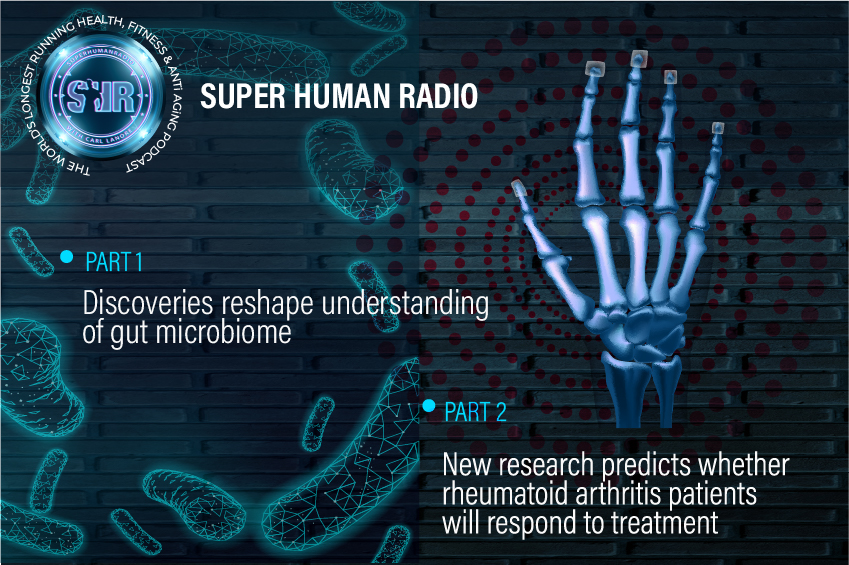
The human gut is home to microorganisms that outnumber our cells by a factor of 10 to 1. Now, discoveries by scientists at the Oklahoma Medical Research Foundation have redefined how the so-called gut microbiome operates and how our bodies coexist with some of the 100 trillion bacteria that make it up. The new findings appear in the journal Science and could lead to new therapies for inflammatory bowel disease and people who've had portions of their bowels removed due to conditions like colon cancer and ulcerative colitis. They also help explain why the use of antibiotics can create a multitude of problems in the digestive system. PLUS A new study led by researchers at Queen Mary University of London provides potential novel biomarkers for predicting patient responsiveness to disease modifying anti-rheumatic drugs (DMARDs). Rheumatoid Arthritis (RA) patients are commonly treated with disease modifying anti-rheumatic drugs (DMARDs) despite the fact that up to 50% of patients are unresponsive to treatment. Up until now, there has been no way to find out whether a patient will effectively respond to treatment.
Studies discussed on today's show OMRF discoveries reshape understanding of gut microbiome - https://omrf.org/2020/10/22/omrf-discoveries-reshape-understanding-of-gut-microbiome/
Blood pro-resolving mediators are linked with synovial pathology and are predictive of DMARD responsiveness in rheumatoid arthritis - https://www.nature.com/articles/s41467-020-19176-z
Show Notes:
[3:00] What inspired this study?
- The need for understanding the connection between the microbiome and the mucosal barrier in the intestines.
[4:00] Mucosal barrier.
- It is made up of glycoproteins that are 3-5 thousand amino acids in length.
- Very tedious to study because of its complexity.
[6:25] Purpose of the mucosal barrier.
- The epithelial barrier- limits the microbes from interacting with immune cells.
- Muc-2 forms the outer “niche” layer for the microbes. Also forms barrier to keep the away from other tissues.
[9:55] How does pH affect the mucosal barrier?
- The mucus system changes as it progresses through the digestive system.
- The stomach is much more neutral.
- pH gets more acidic in the intestines.
[11:30] does the mucosal barrier “direct microbial traffic?”
- It inhibits microbes from going ot places where they are not favorable.
[14:14] Study design.
[16:00] What makes the mucus?
- Specialized epithelial cells called goblet cells.
- Stomach cells produce MUC-5AC
[20:50] Do all of the mucin producing cells use the same substrate?
- Mucin production requires amino acids, sugars, and enzymes.
[23:20] Can the barrier be improved or reestablished?
- Mucus production was controlled by the microbes in the mice.
- Fiber didn’t seem to damage the tissues of the digestive system.
[26:20] Fiber
[35:08] What is the biggest discovery of this study?
- How the gut handles the complex community of the mucosal barrier.
[50:20] Unexpected findings?
- The mucus responds to microbes and not fiber.
[55:00] Any contraindications with the mucosal barrier?
[58:23] Is there a way to test for lack of the mucosal lining?
[1:07:16] Rheumatoid arthritis treatment response study.
[1:12:27] Study design
[1:14:43] Inflammation: halting vs. resolving.
- NSAIDS halt inflammation.
- Omega-3 SPM resolve inflammation.
[1:16:02] The 2 scenarios that lead to RA.
- The inability of the body to produce SPM’s early enough.
- SPM receptor defects.
[1:21:20] After discovering SPM in the blood, what was the next step?
- Obtain potential biomarkers.
- Test for these biomarkers’ reliability in a completely new set of subjects.
- ~90% accuracy from the prediction of these biomarkers.
[1:24:40] SPM supplements.
[1:28:20] The enzymes responsible for conversion to SPM’s
- Lipo-oxygenase family
- COX family
- Cytochrome
- Hypoxide hydrolase