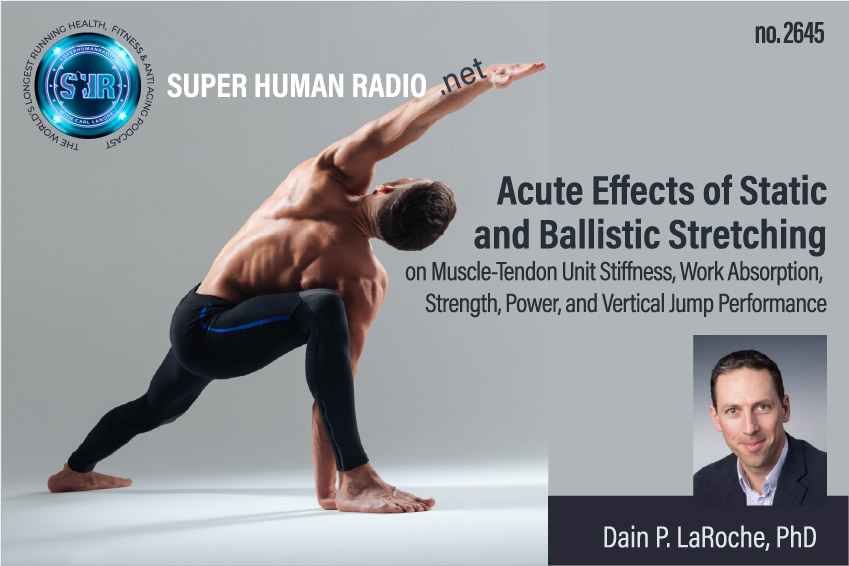
Dr. Dain P. LaRoche, Ph.D.
This study looked at the effects of static and ballistic stretching on muscle-tendon unit stiffness, work absorption, strength, power, and countermovement vertical jump performance.
Show Notes:
[2:48] Why study ballistic vs. static stretching?
- There were no mechanistic data recorded in the past.
[3:30] validity of studies showing detrimental effect to power from static stretching.
- Timing matters, and regularity in stretching can show increases in performance over the long term.
[6:13] Ballistic and static stretching defined.
- Ballistic is more of a bouncing dynamic motion than static.
- The goal is not to hit an extreme range of motion.
[8:45] Doe stretching reduce the stiffness of the tendon and reduce power?
- It is possible.
[11:55] Study design.
- College age men and women who were physically fit but not athletes.
- No stretch group.
- Ballistic group
- Static group.
- Dynamometer was used to measure resistance force.
[15:50] Results.
- Power decreased an average of 8% in the static group.
- Strength was not altered much in either group.
- The differences are probably due to the amount of time spent per stretch in the fully stretch position.
[18:53] Does muscle type affect this?
[19:25] What is work absorption?
- The area under the muscle tension curve.
[20:00] Recommendations for an athlete.
- Static a better for reducing stiffness (gymnasts, dancers, etc)
- It is better to save static stretching for after lifting.
[26:50] Increasing strength at the fully shortened and lengthened positions fo the muscles.
[29:30] Does stretching before training increase chance of injury?
[32:41] dose response relationship in stretching.
- There may be no negative effects from light stretching if you wait 20-45 minutes until performing.
[35:15] Loaded stretching.
- Made popular by Dante Trudell and DC training.
- Also used in Scott Stevenson’s Fortitude training and Ben Pakulski’s MI40X.
- Shown to induce hyperplasia in various animal models when the stretch is held for long periods of time.
[42:54] Best practices.
- 3-5 days/week of static stretching for 15-20 seconds for general health.
- Possibly better at the end of the day.
[46:35] What our ancestors did with a stretching component. The benefits of whole body movement.
[48:30] The importance of walking.
[53:15] What should clinicians and laypeople take away from this research?
- The benefits of static stretching occur in the long term and acute timing matters.
[59:33] What Carl is doing for the new year.
- He has walked 45 minutes every day.
- His maladies are already getting better.
- Less leg pain, better balance, etc.