Dr. Ioannis Chasiotis
Collagen fibers can be stronger than steel. But it requires stretching the fibers and then allowing them to recover. What's the sweet spot? How about older adults? And interestingly, how are high blood sugar levels making it easier to have failure of muscle tendons?
{mp3}https://dts.podtrac.com/redirect.mp3/superhumanradio.net/components/com_podcast/media/mp3s/SHR_Show_2304.mp3{title}SHR_Show_2304{end-mp3}
{spoiler spoilerID,Click to read Show Transcript,Click me to close}
[00:00:00] Hey, welcome back to another episode of superhuman radio. It's a new week. We've got lots of things to discuss this week. Lots of exciting shows are going to kick it off with a science-based show. We're going to talk about collagen Nano fibrils and how they respond to exercise and resistance really in just a moment very very interesting subject.
[00:00:50] You know, we've done shows about collagen in the body over the years, especially as it relates to the. Tired [00:01:00] hypertrophic effects of exercise, you know, a lot of people look at animal protein and leucine for mtor and all these other things that they forget that collagen makes up a large portion of the fascia of the muscle and understanding how that response to exercise is is important we're going to get into that a little bit and just a minute.
[00:01:20] I've had people sending me emails asking me about how the foot is doing. I see my doctor tomorrow. I think the walking boot comes off and I'll actually start to walk. Like a normal person again, and that's all I'm going to do in the beginning. I'm just going to get up every morning and walk for a half-hour and slowly ease into an hour complete reconstruction of the foot is going to take time for the foot to get back to normal.
[00:01:44] My goal is really to be dead lifting and squatting by the end of the year. Realistically. I don't think it's going to happen any sooner than that, but I appreciate all the emails and messages and well wishers. Thank you so much. So today we are being joined. Hi [00:02:00] doctor, yanis hazardous. How you doing?
[00:02:03] how are you girls? Good morning, and you are with the University of Illinois in Urbana, right? That's correct. Now you're in you're actually in the engineering department, which is interesting because we think of Engineers working on equipment and machines but we forget that our human body is a machine as well.
[00:02:20] This is true. And we also work on materials and Human by very often is an inspiration for new ideas for new materials that will make. Better machines have you like interesting? So this particular study that you did looking at the changes in mammalian collagen Nano fibrils and as a result of exercise and when we talk about exercise, it's really probably the wrong word.
[00:02:47] We're really talking about adaptation changes to resistance in the in this particular thing. But what what what led to this what studies preceded this that made these unanswered questions [00:03:00] required to answer actually this was this study was kind of an alignment of interest between different people people in Orthopedics at the University of Washington and Columbia University.
[00:03:12] So I have two collaborators there Steve Thermopolis and Guy Janine. And myself in engineering as you said and very interest stem mainly from an issue that they saw over and over with surgical repair of rotator cuffs and depending on age. These failures could be anything from like 20 percent to 90 percent.
[00:03:34] And what is interesting is the potential bone connection. There is material that gradually transitions from the software. If you like tendon to the harder and stiffer bone and that material is not really taken into account when surgeries done repairs done. So we had done a preliminary study a few years ago with them where we create a scaffolds out of polymers common Plastics [00:04:00] if you like which are biocompatible and.
[00:04:03] Their feature size was that of the collagen fibril that you mentioned earlier in this newest study was about and then we showed the ability actually of Engineers to bring in new tools to the table and give us better understanding of what happens not at the tissue level, but at the level of the building blocks of the tissue and these are the collagen.
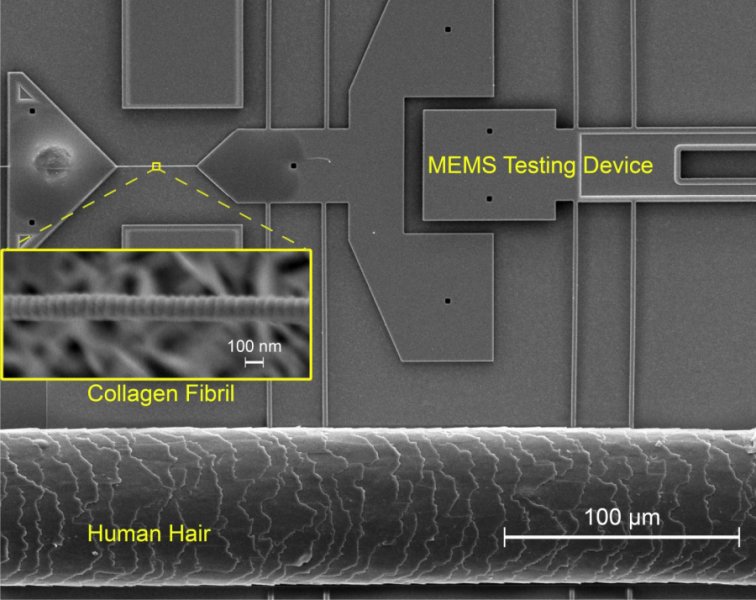
[00:04:25] So you actually had to create a tool in order to measure the strength of these fibrils because these fibrils are I think in your study you say there one one hundredth the size of a cross-section of human hair, right? Great in the cross section of a human hair, which usually we think about it as being a tenth of a millimeter.
[00:04:50] If you like in diameter one could fit about 1 million of these fibrils. Wow. Hello, which makes [00:05:00] them tiny small as well. It's a scary thought if you want to handle one of these and pull it and stretch it but not only pull it and stretch it but actually get usable data out of it. And this is the amount that it stretches for the amount of force that you exert to it.
[00:05:16] How do you build a how do you build a machine? That is so small that it can it could do that. I mean, I'm I'm envisioning this I'm thinking how do you do that? So the machines are small you. Think about maybe 10 20 of these machines feet at the area of your smallest finger finger nail. You can fit 20 machines in there are more of those I said the collagen fibers are tiny.
[00:05:42] So the machines have to be smaller as well. So the machines are of the orders of hundreds of microns again, you're here, sir. And these machines are not only actively stretching the fibers, but they are getting readings of the resistance in sort of [00:06:00] this is this, you know, that alone is astonishing quite.
[00:06:05] Wait, correct, and this is what we brought to the table. If you like in this study when we started working with Steven guy from the Orthopedics Department. We developed tools over the years to study materials at very small scales. We call them nanomaterials. Very small if you. And we have started mainly working with man-made polymers that we can make them and refine them as such but this man-made materials have a lot of commonalities in terms of structure and properties with collagen and there was a lot for us to learn from collagen and we took that direction just to get a little bit to your question about those machines those micro.
[00:06:43] They are made out of silicone of all so this is the silicone that we make Electronics Jeeps for processors and for our computers. The process has been developed an optimized over the years. It started sometime in the 90s and in the 2000 and so on. [00:07:00] Have been more widespread just an example micro machines made exactly the same way as our testing machines for the collagen also exist.
[00:07:10] They do different functions. Of course, they do exist in your cell phone. That's how you get a reading of direction. If you like as gyroscopes and accelerometers in the air bags of a car and I'm wearing I'm wearing an aura ring. Oh you are a I don't know if you're familiar with these but these are activity trackers attracts your sleep and it's a ring.
[00:07:29] And I One Day took a magnifying glass because it's clear you can see into it and and the surface board technology that we have been adapted to today is is is unbelievable how small little thing, you know, I remember when I was in the radio communications business in the 80s and surface board technology was evolving to where they could put, you know, resistors and diodes in little little little packages.
[00:07:59] Boards and [00:08:00] and and robots sorted these things in a flesh now. It's gotten so small. You can't even they look like little hairs. Everything looks like little gold hair is that's what it looks like. It's amazing, correct. And these are the electronics lines the power lines. Now, if you look at the actual devices in there, probably you can't even see them with your naked eye right that take the measurements of gyroscopes and accelerometers.
[00:08:24] That's amazing. And so these devices were called me me right mems. Micro method mechanical systems, correct. It stands for micro electrical mechanical systems because they perform both mechanical functions and electrical functions. They move their mobile devices. You apply a bias and electrical bias and they can move and do things for you or they can sense people have come up with different ways to read them over the years.
[00:08:50] We read them optically and we have a method to convert images into Data out of them. But they are very versatile. And I [00:09:00] said you find them in many applications are there that it's we don't even suspect the other now, then you had to then you had to isolate one single collagen fibril correct, or is that not correct?
[00:09:12] So the collagen that we studied is what we call reconstituted collagen. It comes from mammalian collagen bovine collagen. So we establish the relevance to human collagen its type 1 collagen which. Pretty much looks the same regardless what organism you're going to find it as long as it's type 1 it does differ with age in humans.
[00:09:33] So it does get cross-linked and harder Etc over time and we can discuss that but the basic features were there and it was reconstituted. Basically the was put back together in the lab. So this was collagen at one point bovine collagen was broken down into basic components and then it was resynthesized in the.
[00:09:53] In the form of fibers now, we don't synthesize something very dense as in human tissues, or we can pick [00:10:00] the individual fibrils out of it. And this is done on under high magnification microscope where you can actually see of the all these guys swimming if you like in a in a buffer solution and so then you isolate one and you get it into the me me the mem and you let the men do its job and what it does is it puts it under a strain?
[00:10:22] Well it stretch it it reads and you're looking to see where it breaks. I would imagine initially to see what the breaking point of the fibril. Is that correct? Correct? So so the date of force and how much it extends tells us how it behaves interestingly. If you look at the behavior from beginning to all the way to failure.
[00:10:44] It looks a lot like rubber stiffer way stiffer but like rubber which means it does give quite a bit. It's very resilient as a. So that kind of triggered our next level our next study which was to see how this [00:11:00] behaves if you load it and you unload it, but you don't let it fail yet. And this is where the training aspect came in our studies that you mentioned before so so that's very interesting because we take it for granted the physiological changes that occur from resistance exercises.
[00:11:22] Since it's like lifting weights, we know that the body has a type of intelligence in it that is designed to Super compensate to protect you from exertion. So you do something a few times the body goes out he's going to do this all the time. So we need to get stronger in doing that and this super compensation up regulates.
[00:11:45] Tissue Aubree later up regulates nervous system deployment up regulates all these different mechanical functions each of them on their own system in order to continue to be able to do that work and do it more [00:12:00] efficiently and maybe even do it better and the body does this intelligently. So when you look at these Nano fibrils, they ended up themselves have that capacity to Super compensate overtime.
[00:12:10] Isn't that correct? This is absolutely right the capacity for to carry large forces it is there all along simply those nanofibers are not utilized as such and and there's a reason for that nature probably doesn't want them to be utilized in their full capacity because they will fail. And instead of breaking we would like them to rearrange and realign and the more they realized through again exercise into quotation marks.
[00:12:37] Then the the stiffer they get in more efficiently force is transmitted through the body. So even if you look at that, the fitter level collagen is still there has the same structure but it is not aligned. It's very it has lot of crimps if you like. And you need to stretch it to open those up and over time halogen aligns more and more in our [00:13:00] body.
[00:13:00] So often we say that nature optimizes materials in organisms, but in reality in nature designs for survival and resilience, and that's a very good point where the basic building block. This is the college. Has all the strength there in it and the resilience. It is an amazing material by itself because it's both strong and extremely resilient.
[00:13:22] Unfortunately man-made materials are not that good and On Demand by just aligning it over time or through exercise or other means it can actually carry more Force than what you usually do or just do its basic function. So I tend to make a parallel if you like. Just please please will give an example to you.
[00:13:44] Yes to spaghetti. So, you know, if you're still denying your plating has enough sauce in their spaghetti will be random. All right, and if you try to pull one out, it's going to come out easily. Now. If you let all that kind of [00:14:00] align it kind of put it all going in one in one direction and you let the sauce dry if you like.
[00:14:06] Okay, cool off then all these guys will start moving in sync right cause they're held by the the cooler. - that is in there. And so then they can if you try to pull one out of it. It's not going to come out. Okay, because it can carry much more and you also you also have you also have the the role of friction along the length of each of these fibers where they're touching together.
[00:14:31] They actually gain strength from each other in that instance in what you're describing, right? That's precisely right the better they aligned they closer they are to each other and there is. Interaction with him more friction. And so that friction makes them as a whole now said in the tissue to behave stiffer and stronger.
[00:14:54] So what what actually over time and exercise for [00:15:00] will using that term today to exemplify what we're doing to influence them over time and exercise. Causes them to align is there an aqueous solution between them that allows them to reposition over time and what what tells them to reposition that's fascinating to me.
[00:15:21] So any position in comes because of an external stimulus, so that would be a force or amount of stretch right now between them there is matter and this matter it goes by the name, but Polly glycans, so that'll that is softer mattress. And it allows them to repositioned holds them together. So they don't come apart because there are fibers if you squeeze them they will just come apart only when you stretch them.
[00:15:45] They will follow so fibers usually work well intentioned but not in compression when you squeeze them so Polly glycans hold them together, but they allow them to rearrange in response to an external load and regardless what the [00:16:00] external load is in an actual inhuman. It never reaches their maximum potential.
[00:16:07] Either in dry conditions may be especially beautiful in dry conditions collagen fibers are very strong. They are stronger than steel actual. That's amazing. Now. I know that there is a at the at the insertion and an endpoint of all muscles. There is something called the Golgi complex. I believe it's called and it's a an apparatus.
[00:16:36] That has a role in proprioception and it actually is designed to be a governor. It's actually designed to give feedback to the brain when when you're pushing your your self into a Zone where you could actually snap attendant for instance or pull it from propeller from the bone and devotion. Does that play a role in [00:17:00] both?
[00:17:01] Inhibiting damage of the collagen fibrils, but also telling the body it's time to up regulate and realign fibers because we're getting into a danger zone. Again to the that's exactly my expertise and I think this is more International regulation. Okay? Okay, but I think at the at the collagen level the processes more passive.
[00:17:26] It's a kind of a self-regulating process in other words the. In fibrils are not fully stretched to begin with they have enough enough of creams and way Venus in them and forces a set of forces between them are the ones that regulate automatically if you like what purpose they will take in whether they were real line so collagen fibrils themselves internally.
[00:17:50] They are the atoms in there. If you look at just at the very very basic level, they are strongly connected, but they're not fully. So this way [00:18:00] business allows them basically to separate from each other without necessarily putting enough Force to break them apart. So there's this basic structure of the atomic bonds between the atoms right?
[00:18:12] But then you have to look at the molecules in there. And these molecules are basically sliding past each other through some weaker Force. And it is those weaker forces that allow things to move without failure and there's a lot for us to learn. This was part of my motivation as an engineer designing materials to learn the balance between the two the more fundamental strong forces between atoms that are extremely strong and once you overcome them, the thing breaks and the weaker force that work forces are the forces that work like glue like the sauce if you like in the pasta that.
[00:18:49] The spaghetti strands to move past each other but not break in one strike this balance ride. You can make materials. They're both strong and [00:19:00] extremely resilient like the collagen fibrils. Well, and when I'm really interested in is how do we make collagen fiber stronger and active living people and you you kind of discovered that in this this research to what I want to take a commercial break and when we come back I want to delve deeper into the study itself.
[00:19:16] Stay tuned. You're listening to superhuman radio. Right back, welcome back were talking with dr. Jonas Jonas were talking about how your collagen nanofibers respond to exercise. So let's talk about the research itself. So you you discovered a point. I guess the optimal stretching. That actually caused an increase in the strength of these individual nanofibers, correct?
[00:19:49] Correct. Yes. This is correct. And what was that? What was that? So we basically progressively took individual collagen fibrils those tiny tiny little strands. [00:20:00] Basically it we described earlier and we stretch them cyclically. We loaded them and we unloaded them at different levels of extension and only found that.
[00:20:10] Small extensions, but probably that's pretty much what you see in human body and nothing more than that. Nothing happens. Basically, you can stretch it and let it go and nothing will happen at all. But as a parentheses and interestingly that collagen fibril itself would extend return back and dissipate some energy.
[00:20:32] So that was a finding by itself because most of the time in literature people consider the collagen fibrils as nausea. But the dissipative element in our body basically doesn't dissipate energy and it is the matter around them. But that's all that however, it does show that even the basic building block.
[00:20:50] That is the fibril does dissipate energy and provides resilience and and just to put it in perspective dissipating energy. It is not a bad thing in [00:21:00] this case because it helps the rest of the of the connective tissues to prevent basically overloading but then. But this lot of those fibers further to highly higher forces and higher stresses and we saw that the dissipation was going up and up more and more actually just the collagen fibril itself is more dissipative than any other man-made material in its class in terms of how much energy it can take away per cycle.
[00:21:30] So but we found that be on some level of loading and all the way near failure like 95% of the strength of the fibrils. They. Get stronger and they can get pretty much as much as a hundred percent stronger or maybe seventy percent stronger than what they are. Otherwise over what period of time over what period of time the loadings basically take each cycle its loading Cycle takes minutes to hours.
[00:21:59] They're [00:22:00] not very fast. They can take a few minutes. They can take an hour. We haven't seen a difference there significant difference there and but what is significant is that although it gets stronger. It does not get less resilient. In other words the total amount that it can stretch before failure Remains the Same.
[00:22:21] that's impressive because you would think that the stronger it gets it wouldn't stretch as far because. You you mean it that just goes hand in hand. If you think of a rubber band that's very thin. It stretches very far and you go to a rubber band. That's very very thick. You can't stretch it as far with the same amount of force.
[00:22:39] It's just so that's interesting correct in again as an engineer. I refer back to man-made materials based on understanding that if a material is strong then it's going to be what we say breathe. Didn't want stretch as much right and if you give it enough ductility, well, then it won't be a strong material.
[00:22:56] But here we have both and as I was [00:23:00] saying before giving my analog of spaghetti, if you like it what plays a huge role is the sauce in the pasta that allows for the strands for the spaghetti strands to align but yet Stay Together. Interesting. So now the other thing that I'm interested in discussing is this is especially interesting to women so we know that the skin starts to Sag as we get older.
[00:23:31] And it's blamed on The Matrix of collagen in the skin over time because the collagen as you point out in your in your in your paper to that. While college and stretches it doesn't spring back the way rubber does right and sometimes it doesn't go all the way back to its original length, right? And so great this stretching of collagen probably plays a large role in its ability to upregulate and handle more resistive [00:24:00] forces, but what people really wanted their collagen to go back to where it was because that's like a part of aging the collagen starts to stretch and stay that way.
[00:24:09] Did you discover anything that. Give us a an idea of why this happens why it doesn't go all the way back to where it belongs what was originally and maybe we can influence that with something. Yeah, so this is actually the next step in this study the immediate Next Step. So the collagen we started said was reconstituted collagen from from cow.
[00:24:32] And that collagen was remade in the lab, but it wasn't an aged collagen or immature college and as we call it otherwise, so in the human body the collagen is basically synthesized in similar way and it starts when we're born similar to what we study in the lab. But over time within the collagen thinks form that are called cross-links.
[00:24:56] Basically if you look at again back to our spaghetti analog the [00:25:00] individual spaghetti strands now a. Load through some hard at some hard points. They're not allowed to slide past each other anymore. And this thing happens more and more as we age now. There are other factors sugars and other things that accelerate this process and for more of these cross-links now if you put those little feathers, The collagen fibril strands then they can't really realign as my interest and that happens also inside the individual strands the fibrous not between fibrils only but within individuals fibrils, and so that makes them conceivably little bit more strong over time.
[00:25:39] But yes, absolutely. They're not going to they're not going to go back and we especially if the college in itself is becoming compartmentalised by these little walls. Let's say. You will within the Strand they're not it's not going to be able to go back to the original length at all corrected one be able to dissipate as much energy there because it doesn't have as much movement if you like [00:26:00] as it would have otherwise, so why did you think sugar you said shoot?
[00:26:03] So so are you saying that in the human body high levels of sugar could create this cross-linking phenomenon more readily? Correct, the catalyze some of these reactions and they happen faster. So if you like a side effect of driveability problems is to have issues that reflect to the collagen structure as well.
[00:26:25] And the older we get collagen basically doesn't break down in reformists as easily. So we're pretty much stuck with some of that. Ah, so what you're saying is some of the collagen actually becomes metabolic debris that normally would have been. Broken down and carried away and replace with new collagen but it just stays there old collagen.
[00:26:45] It does get much harder. I mean collagen is resorbable. Basically if you can break down and reform and but the more of these cross-links form the much harder it is to break down for instance. The collagen, you know, we formed in the [00:27:00] lab that didn't have those cross-links and we call them mature cross-links because of the aging process.
[00:27:05] We didn't have those cross link. So if you put it in a light acid like vinegar it. Dissolve but if you take mature cross the cross link basically collagen, it will not even in light acids. So it becomes much more resistant and in some sense. It has a positive aspect of these cross-links provide the proper positive aspect because.
[00:27:26] He makes it over all locally stronger, but you lose the resilience and one way to look at collagen is as the accommodator basically accommodate what's around it and it needs to have this resilience in stretchability. Once it loses it. Everything becomes problematic. This is this is a total tangential this topic.
[00:27:52] I'm going to mention to you, but I just think it may be interesting if. If you're aware of this, I had a doctor come on our show about two years [00:28:00] ago. Who talked about the herbicide glyphosate or Roundup and his laboratory had discovered that glyphosate was a synthetic form of glycine and we know that glycine makes up collagen.
[00:28:22] It's a big big player in collagen formation. Yeah, and his lab discovered that exposure to a long-term exposure to glyphosate cause this synthetic synthetic form of glycine to be incorporated into soft. And the body cannot break down glycine like it. Can I mean I cannot break down the synthetic form of glycine, which is glyphosate like it can Glycine and it leads to a phenomenon called amyloidosis.
[00:28:56] Which is basically a fibrosis of soft tissue [00:29:00] because that doesn't turn over as you're pointing out. I just wanted to throw that out there to you not because you're in that space but it'd be interesting. If you start using you know cadaver glice fibers and you notice something funny. Like wow. Why are these are young and why are they not breaking down there?
[00:29:20] There is a there is a group of scientists in the United States today who will worry. About the incorporation of glyphosate into soft tissue and it becomes metabolic waste. You can't get rid of it. You'll carry it for the rest of your life. Just thought I'd throw that out there to you interesting.
[00:29:35] This is interesting, you know, it's totally outside my territory if you like but definitely one has to understand that chemistry is very complex and. Just like I mentioned before cross-links can form. Naturally. They can also be accelerated by maybe an over abundance of glycine or other aspects there or this [00:30:00] could have also many other agents there that accelerate the cross-linking it takes basically take some minerals and some long molecules to form those cross-links and if they are present it might just as well happen, but there are other aspects that one has to think about and this is also.
[00:30:16] Mineralisation for instance of collagen fibrils overtime minerals form these minerals go by the name hydroxyapatite they form and they make the collagen fibrils also stiffer if you like and harder and that can make them also with aging less resilient. That's also something that we are investigating more in connection with the tendon to Bone connection the emphasis because right there we would like to have some mineral but that's all.
[00:30:46] Another aspect that affect significantly how our collagen fibers behave with age. Yeah. This is this is amazing and you know, and so my natural question is why would the why would the Basin will talk about petrification [00:31:00] the petrification of soft tissue the way we see a petrified tree that's been in a in a stream for a thousand years becomes burdened by all the minerals that it's absorbed and it still looks like.
[00:31:12] But it's yeah, it feels like Stone and so the petrification of soft tissue is what you're discussing here. And that's that's really astonishing to me because that's worrisome because we have become we become inundated see I actually take a supplement that's made from hydroxyapatite because it's a bone Builder.
[00:31:34] I have a I just had surgery and so I need the bone tune it faster. And and so I've been taking that. Woman that you're telling me that may lead to calcification of of my soft tissue. I don't like that. I don't like that at all. Well, it definitely depends on the rest of the chemistry in your body and you certainly need it.
[00:31:55] So as I was saying before looking at the certain [00:32:00] point in our body where we have collagen between the tendon and the bone, we would like to have a variation a gradual variation of hydroxyapatite in the form of. Precipitated mineral on to the collagen so that the collagen properties gradually changed from those in the bone to those in the tendon, right?
[00:32:21] Because of a change too quickly you're going to have basically a cold seam if you will where it will snap it will snap. This is absolutely right and that was our initial incentive because eventually the The Orthopaedic people in this in this project. They want to every time they say this surgery they would like to put a scaffold in place.
[00:32:47] That will mean. The end of the bone connection as close as possible to the actual body most of the time whenever there's those remedial surgeries done the scar tissue [00:33:00] forming and that scar tissue is a hard place where failure can happen over and over so understanding what the proper gradient if you like this this variation is gradual variation of mineral is between the bone and the.
[00:33:14] Would help us to to do things much more effectively. Now, I want to mention one other thing, you know, I so, you know, it's funny. I've been doing the show for over 13 years now and I've done so many interviews that I see where they overlap and they intersect and so you were talking about sugar causing this premature connections.
[00:33:32] If you will between the collagen fibrils and limiting their ability to stretch and go back into place and we know that in. Helen can actually affect mineral absorption and tissue we know that high insulin levels actually can disrupt magnesium and calcium channels in muscle fibers. So we know [00:34:00] that insulin plays a role in how minerals get stored.
[00:34:05] In tissue and and we come back to the whole type 2 diabetes population people with ragingly high insulin levels for decades and decades and and now I have to ask myself gee. I wonder if the reason that they have, you know, I know a lot of people have gotten out of a car and snapped an Achilles tendon.
[00:34:24] It's like really now I'm starting to think wow. Maybe the insulin is causing. The minerals they literally petrify the soft tissue and the soft tissue is not soft anymore. It's brittle minerals and cross-links and so on and just do to make a good point here. I'm trying to to basically draw also lessons engineering lessons from all that and a whenever we want two things together think of bone and Tenten don't for instance naturally as humans.
[00:34:56] We would think that the strongest glue would be the. The [00:35:00] strongest and stiffest glue, correct. So things don't don't move but actually what one needs is something that is strong but not extremely strong but one that allows some gifts so it gives right and if there is calcification if there is increased cross-linking in the collagen.
[00:35:20] These place not there. So energy is not dissipated its transmitted right through it finds a weak point and and there's failure. very interesting, so. What else did you discover about the ability of the collagen to go back into place? I know that there was such a couple things that that were very very surprising about this study.
[00:35:45] So the the most surprising surprising thing was the fact that despite this cyclic loading. We did it sometimes like 440 times and so on we saw this this increase in strength and that's still [00:36:00] the underlying cause of that or reason for that is still loose. If we don't know exactly what happens. We have an understanding of potentially that it is all these interactions Within.
[00:36:13] Molecules that allow them to slide but and get better aligned and overall get stronger, but the surprising thing is what we mentioned earlier that although it gets stronger it still maintains its extensibility its ductility. So it allows for that and also the energy dissipation that was important a lot because the study was not done in fully hydrated means inside water College in the collagen was wet.
[00:36:41] It had most of the water in it, but it wasn't inside water whether one would expect that water will be squeezed in and out from the collagen fibril and would allow for some energy to be dissipated. So so that was that was new and we need to follow up on that. Are there any further [00:37:00] study any of your any of your research in this area can it give us any clues into as we age that there may be things we want to do to improve and maintain the pliability and malleability of soft tissue in the body.
[00:37:16] I can provide expert if you like advice to that. I think we mentioned before about sugars. That's an important one. So we want to limit as much as we can if you like. The formation of those cross-links in collagen. Is there any way to break down the cross leaks once they're formed? In the lab, they don't break down.
[00:37:41] If you use acids, they just you need to use some strong acids to get those bones out and break it so I don't think the body has the ability to do that. But again, I can't talk as an expert about yeah, and it seems like the body is doing that for a reason. Doing that because of the [00:38:00] it needs to strengthen and get against the potential rate reaching a breaking point.
[00:38:06] I want to take our last commercial break when we come back. I want to talk about the seven. I think you said 70% was the magic stretching them at 70% produced the greatest results. Let's talk about that when we come back stay tuned. Welcome back to super young radio talking with dr. Jonas house showed us were talking about how your collagen fibers respond to exercise.
[00:38:27] So 7. Scent of load of maximum load, right the snapping load seemed to be the Magic in producing the greatest upregulation of strength while not impairing the ability of the fiber to retract. Is that correct? So yeah somewhere at about just to put it in terms of amount of stretching if you like a relative stretching if you stretch them to about 15 to 20 percent of their.
[00:38:57] Then the increase in the strength [00:39:00] goes to as much as 70% and an interview increase the amount of stretch that one make a difference. You still get that 70% which twice it means that the something at that amount of stretching that gets released in realigned if you. That allows for much higher strength and a lot of it will have to do with the way the molecules inside the collagen fibrils align with each other.
[00:39:28] And so just to put a little bit in perspective though to your audience. Yes, you do get higher strength, but these things are not achievable in any human function their extreme and they are there because every time College. Bundle of collagen fibrils forming collagen fibers and and fascicles get stretched not all fibrils actually carrying load some of them are there and they go along for the ride, but they don't really do anything and some others carry more load than others.
[00:40:00] [00:40:00] So this resilience is built in as well to take into account the fact it's building by nature to take into account the fact that not everybody carries their own way. They're in the process. So when you say it's not it's not achievable. To reach some of these these limits. What about somebody who's a competitive powerlifter somebody who's squatting a thousand pounds or bench-pressing 700 pounds, obviously that's strength acquisition occurs over decades.
[00:40:32] So there is an upregulation in the structural changes of the soft tissue as well as the muscle itself, but are those people not pushing those fibers to extremes? That would not be seen maybe in the laboratory? No, not that close. I said these strings are very high just to give you perspective the the ultimate strength of the fibers even fibrils even before we trained them, but certainly after we [00:41:00] trained them exceeds that of.
[00:41:02] So, you know and still is a very strong material by your measures. So so but luckily though within the tissue you can see that some of these collagen fibrils not all of them, but some of them occasionally we'll have to carry loads much much larger than average and so this resilience is building. In our body, but I don't think it's utilized anywhere close to its maximum.
[00:41:30] It's probably it's not meant to be as mentioned earlier. I see the collagen and the fibrils Morris facilitators rather than the ones who will carry the majority of the load and they're there to prevent also overload and other issues and provide a scaffold to the rest of the body. It's a. What do you hope both clinicians and lay people take away from this research Doctor Asiata?
[00:41:56] So This research and the follow-up which will be as I said before on the [00:42:00] cross links and mineralisation provides a foundation to us to understand at what level we need to engineer solutions for let's say surgery. Okay in scaffold. So in the past these scaffolds were more designed at the level of microns maybe at.
[00:42:18] Here level human hair level, right and now it comes clear that the basic building blocks that are serving scaffolds in the body. And these are the collagen fibrils are again thousand times smaller than here and they actually play a very essential role both in terms of dissipation and load carrying.
[00:42:41] So we need to design basically better scaffolds whenever we have some of these surgeries and then start taking into account. Details in how the scaffold is structured at the level of hundreds of nanometers if you like, which is a small fraction of the hair right of the human here at that detail is [00:43:00] essential to prevent scar tissues and other things later on.
[00:43:04] This is great stuff and you know, most of the people in this audience I shouldn't I say many of the people in this audience including myself we've. You know, I had to have a tricep reattached and they used a some sort of mesh that they screwed in and then they attach the ends of the tendon to that and it grows over and you're right.
[00:43:27] It doesn't have the same strength as it did when it was all just tendon and it's amazing, you know, you would think that we can make things stronger than than then tendon, but we can't it's really amazing. Thing that it's just wrong as it really is and it only breaks when it's either pushed Beyond its capacity to handle weight or when there is some sort of imperfection that is developed in it in my case.
[00:43:56] I had developed chronic tendinitis in [00:44:00] that elbow. And I ignored it and it became something called tendinosis which is when the tendon starts to separate and unwind if you will at the it's not one single tendon any longer breaks into smaller strands and it doesn't produce the same strength and that's what made mine snap.
[00:44:21] But it's if we take it for granted. They forces that are muscles put on on the skeletal system lifting heavy weights and how these rubber bands if you will for lack of better terms. They're so strong. They just stay attached no matter what we do. It's really it's really amazing and now you're explaining it because.
[00:44:43] When we look at this complex of literally millions of these Little Fibers and we realize how strong these little fibers are. It's really unfathomable as you said. We can't make man-made materials as strong as this. Correct, and and they [00:45:00] bring in I think what I want to emphasize it's also very dungeon.
[00:45:04] See they they have built-in in our body. We don't need such a strong material. But then when the material is not deficiently necessarily use the collagen fibers some of them. Pull some of them are not stretched because they are wavy the ones that are stretched are there to carry the load and have the load capacity in terms of manmade materials.
[00:45:24] This is this is a lesson we're trying to pull from this study in my lab because we've been studying material such as Kevlar, which is extremely. Strong people, you know in this is a plastic. Yeah, but bulletproof bulletproof. Yeah and bulletproof and other such as the high molecular weight polyethylene, which is a substitute for Kevlar which can be even stronger and those materials have enough elements there to take lessons.
[00:45:49] From from nature for instance Kevlar materials have in terms of structure. They have a lot of resemblance to collagen their self assembled as well as their made. Although they are made [00:46:00] at a much harsher environment. They're made in sulfuric acid, but they have a lot of resemblances and they function in many similar ways.
[00:46:08] It's just that there. Elizabeth or quite a bit stronger than collagen by something of the order of 5 to 10 times, but they're not as backed out there about five times less ductile. So there's a balance there that kind of tells you that, you know, you can strike both of them that means ductility extensibility and strength at the same time and a good example is the collagen fibrils.
[00:46:33] This is exciting stuff. I want to thank you for coming on the show, and I want to go ahead and invite you back when the next study comes out because I'll be interesting to be interesting to add that to this discussion. Definitely. Thank you very much Carl. Take care. Have a good day. So, there you go.
[00:46:50] Man, I wonder if there's something else going on with collagen in the body that needs to be discussed as well because [00:47:00] I'm kind of sad to hear that, you know as you get older college and becomes more brittle and stiff, but we know that to be true, but I'm just wondering if. Constantly stretching it and what you can do to turn it over and is there anything that can be done to break down those those connections that seem to make it more rigid as a lot more to this discussion that I have to discover because.
[00:47:22] You know me. I want to keep lifting and I don't want to be restricted by my tendons and ligaments. I that's all for today. We'll see you tomorrow with more superhuman radio. Thank you for listening.
{/spoiler}