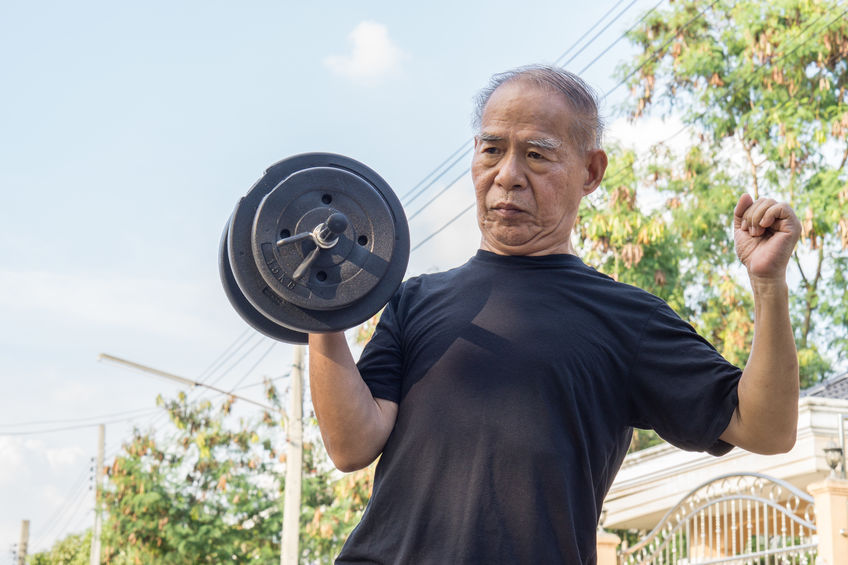
As we age the composition of our muscles change leading impaired muscle function. Many older adults suffer from osteoarthritis that makes them unable to exercise. As they move less, muscle function gets worse. Especially in the prime-movers lie the legs. Eventually this leads to inability to walking stability and falling. We look at two studies when taken together show that that degradation can be reversed by resistance exercise and moving more. Exercise also positively affects osteoarthritis symptoms making moving more easier. This may be the final word on “do we age because we move less or do we move less because we age”. And this is an amazing opportunity for personal trainers and strength and conditioning coaches.
---------------Studies Discussed On Today's Show--------------------
Twenty-Four Months' Resistance and Endurance Training Improves Muscle Size and Physical Functions but Not Muscle Quality in Older Adults Requiring Long-Term Care
https://pubmed.ncbi.nlm.nih.gov/31233079/
Strength training in older adults: The benefits for osteoarthritis
https://www.ncbi.nlm.nih.gov/pmc/articles/PMC3606891/
{mp3}https://dts.podtrac.com/redirect.mp3/superhumanradio.net/components/com_podcast/media/mp3s/SHR_Show_2538.mp3{title}SHR_Show_2538{end-mp3}
Show Notes:
[5:00] Endurance exercise improved muscle function in elderly arthritic subjects.
- It inhibited sarcopenia.
- Did not increase muscle density.
- Hormones could be the missing piece to increasing muscle quality.
[11:00] Osteopenia.
- Connected to insulin resistance.
- More muscle mass could indirectly stave off osteopenia.
[22:34] Training is the best way to stay out of a nursing home.
[34:50] Meta analysis: How strength training affects osteoarthritis in older individuals.
- It increased strength.
- It decreased pain.
[37:20] Neuropathies may not be glycation and instead may be closure of micro vasculature.
- Training addresses this and also increases synovial fluid in the joint.
- Walking can do this and reduce lower back compression.
- Movement is key to reducing pain.
[51:02] Bridging the gap between personal trainers and clinicians.
- Present a sensible plan to the physician including pre and post assessments.
- This is a prime opportunity for “come to you” type training.