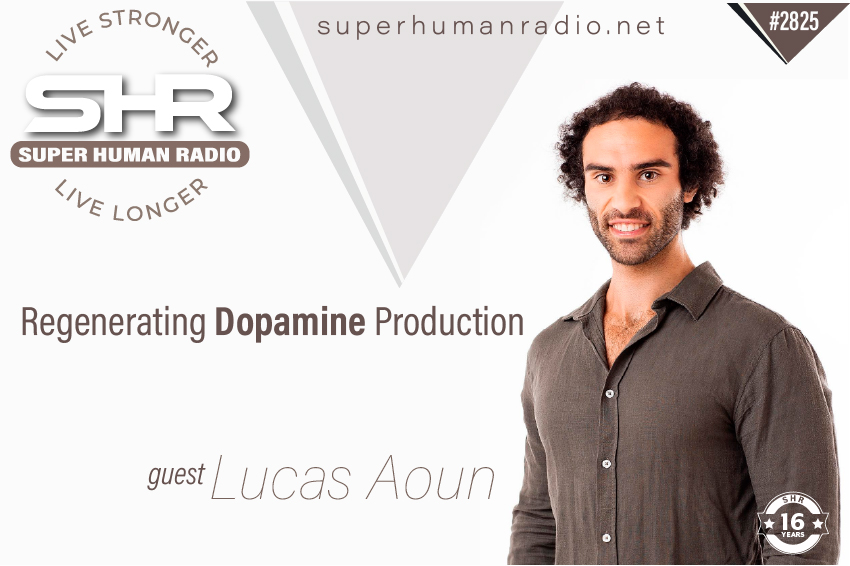
Regenerating Dopamine Production
with Lucas Aoun
Dopamine is a prime mover in neuroendocrine hormones. It plays a role in neuromuscular function, libido, quality of erection in men, quality of orgasm in both men and women, motivation, desire, reward and many more executive functions. As we age, and even some younger people, dopamine seems to wane. Little is discussed on how to fix this problem. Until today's show.
Play
About the Guest:
Show Notes:
Regenerating Dopamine Production
[00:05:57] Lucas explains his fascination with Dopamine.
[00:06:19] The prime neurotransmitter associated with success, dominance and motivation is dopamine.
[00:08:25] A discussion on the newest dopamine agonist drug on the market, Apomorphine, ensues.
[00:10:23] Is dopamine production cyclical, or is it on demand?
- In general, in the brain, dopamine levels are fairly consistent in terms of its cyclical production.
- Dopamine is synthesized from the beginning substrate, L-phenylalanine.
- It is then converted into L-tyrosine, then into L-dopa and then Dopamine.
- There are many other co-factors involved in the process, vitamin B6, zinc, magnesium et.
[00:11:45] Which dopamine converter do people most commonly have a lack of?
- Globally, the nutrient most people are deficient in, is iron.
- Iron is essential to convert l-tyrosine into L-dopa.
- B6 also plays a crucial role.
- Iron however has to be managed as iron can cause severe oxidative stress.
- People on the anemic end of the spectrum do have a decrease in dopamine receptors.
[00:15:09] How does the microbiome contribute to the production of Dopamine?
- 90% of serotonin production begins in the gut. The same also holds true for dopamine.
[00:18:26] What hormones compliment or hurt the production of dopamine?
- There is an inverse correlation between dopamine production and prolactin secretion.
- There is also a correlation between total testosterone production and dopamine output.
- A strategy to improve dopamine production should include something that mildly suppresses prolactin.
- A discussion on safely suppressing prolactin levels, follows.
[00:24:05] The most acute effects noticeable when dopamine levels rise, will be an increase in mental clarity, resilience, focus and motivation.
[00:24:27] Does caffeine abuse cause dopamine to drop?
- Caffeine is a typical stimulant; they borrow from tomorrow.
- There is one particular nootropic for people who abused heavy stimulants chronically, Uridine monophosphate (UMP).
[00:27:32] Maca root effectively increase dopamine production. It usually has a pretty fast onset.
[00:34:33] Are there diets that predispose people to production of dopamine?
- Diets rich in monounsaturated fats.
- A lot of organ meats.
- Avoid high GI foods.
- Anything that worsens insulin resistance is also associated with poor production of dopamine.
- Glyphosates deplete and strip the body of key nutrients like manganese, and manganese deficiency is also associated with low dopamine.
[00:36:40] Any sort of sleep deprivation will exacerbate any sort of neurodegenerative disease.
- Meditation is known to increase brown matter in the brain.
- There is a correlation between dopamine and self-awareness
- Dopamine can increase introspective behaviors.
- Carl follows this up with an ant story.
[00:39:48] Psychedelics like Psilocybin function as an agonist at the 5-HT2A receptor. That leads to a downstream release of dopamine and glutamate. A discussion on both the abuse of recreational drugs and the effects thereof as well as therapeutical use, follow.
[00:44:36] Lucas explains the term “learned helplessness” – fascinating!
[00:54:34] Mitigate post sex prolactin rise by using a stack of 500 mg of L-phenylalanine, 25 mg of Bromantane and small amount of vit E sublingually.
[00:56:25] Stack to optimize dopamine production.
- L-phenylalanine.
- B vitamins.
- Focus on the tyrosine hydroxylase enzyme.
- Coleus Forskolin.
- Lower basal levels of serotonin if necessary.
[01:04:31] Are there ways to assess dopamine levels in humans?
- The Braverman test is the only way at the moment.
To learn more about Lucas
www.youtube.com/boostyourbiology
Stay in touch with us! Get show highlights, tips, new research & offers in your inbox.
Latest Episodes
SHR #3033: The Truth about Glyphosate and Disease
May 02, 2026
SHR #3032: Coming off of GLP one agonist and not putting on a bunch of fat
Apr 14, 2026
SHR #3025: Should You Fear the Fairway?
Feb 21, 2026
SHR #3031: The Sepsis Show
Feb 16, 2026
SHR #3030: Cheating Death
Feb 11, 2026
SHR #3029: The Ultimate Anabolic Steroid Research Guide
Oct 31, 2025
SHR #3028: Slow Aging. Prevent Disease.
Oct 23, 2025

SHR #3026: The Magic of Proper Stress Management
Dec 24, 2023
SHR #3023: The Prime Act - Getting the USDA Out From Your Farmers Way
Sep 19, 2023
SHR #3022: NAD, NMN and NR; Is There Something Safer?
Sep 18, 2023

SHR #3021: The Legend Of Christian Boeving
Sep 17, 2023
SHR #3020: The Sleep Talk
Sep 14, 2023