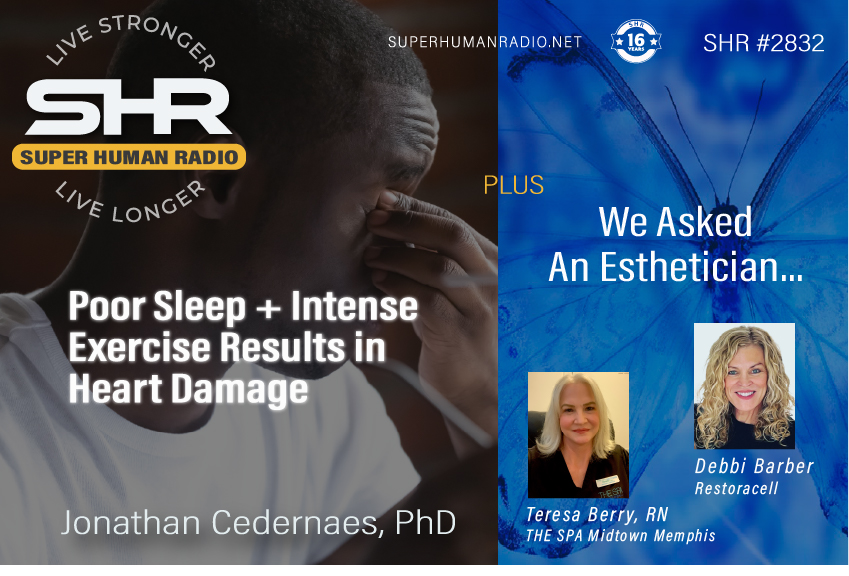
Poor Sleep, Intense Exercise Produces Heart Damage
with Dr. Jonathan Cedernaes, Ph.D. - MD
In a new study, participants underwent an intense bout of exercise after both normal sleep and after three nights of curtailed sleep. When they exercised after curtailed sleep, the levels of the heart injury biomarker troponin increased more, compared with when the participants performed exercise in their well-rested condition. This begs the question if we should take off from training after impaired sleep?
+ We Asked an Esthetician ...
- Debbi Barber & Teresa Berry, RN
We asked a professional esthetician if she could tell the someone had had years of skin damage before using this skin care product, and if she could tell the difference between someone who's spent thousands of dollars on professional skin procedures versus using this same product.
And How to get More out of your esthetic treatments.
Visit http://shrnetwork.biz/blue and use code SHR25 for 25% off.
Play
About the Guest:
Dr. Jonathan Cedernaes
Dr. Cedernaes is a licensed medical physician (Leg. läkare), has a Ph.D. in medicine, and is an associate professor (docent) in medical cell biology at Uppsala University, Sweden. He is currently a sleep & circadian researcher at Northwestern University in Chicago & Uppsala University in Sweden.
He has co-authored over 60 peer-reviewed articles, and has also co-authored a chapter on the role of circadian rhythms in Harrison’s Principles of Internal Medicine. His research has focused on cognitive and metabolic effects of disrupted sleep and circadian rhythms, both in humans and in animals.
Dr. Cedernaes is also interested in science communication, including about the coronavirus SARS-CoV-2 and COVID-19. He is currently active as a moderator of the Swedish medical doctor Facebook group on COVID-19 research, which has over 21,000 members.
Dr. Cedernaes is also an ambassador for the public outreach committee of the Society for Research on Biological Rhythms (SRBR).
Show Notes:
Poor Sleep, Intense Exercise Produces Heart Damage
with Dr. Jonathan Cedernaes, Ph.D. - MD
[00:04:56] Why this study, why did you look at the effects of a lack of sleep and intense exercise?
- Prior evidence suggesting that sleep is related to the risk of cardiovascular disease.
- Evidence to suggest that sleep can modify how damaging certain stimuli could be.
- Animal studies show how damage occurs at tissue level during an intense period of sleep deprivation.
- There is a dose dependent relationship between how much sleep you get and risk of various diseases.
- We wanted to study whether exercise could be used as a countermeasure for certain adverse metabolic effects of sleep loss. But at the same time, we were also interested in the fact that exercise is a stressor.
- Exercise can mainly be seen as a positive stressor, but it does add stress to yourself because if you do it at a high enough intensity, you are putting a lot of strain on your cardiovascular system.
- The question was, what are the factors (during heavy exercise) that determine the extent of increase of biomarkers indicating cardiovascular disease?
- One often overlooked factor in many studies was sleep.
[00:10:33] Which cardiovascular diseases are assigned to people who have sleep deprivation?
- Less amount of sleep is linked to
- all cause higher cardiovascular mortality and cardiovascular disease
- higher incidents of hypertension
- arrythmias
[00:12:05] Troponins are a group of proteins found in skeletal and heart (cardiac) muscle fibers that regulate muscular contraction. Troponin tests measure the level of cardiac-specific Troponins in the blood to help detect heart injury. It is normal to see Troponins in the blood of people who exercise intensely, because there is a hormetic effect to the heart during training.
[00:15:17] How much of the phenomenon with the heart and the increased Troponins could be assigned to some metabolic inflexibility?
- Added contractions and increasing stress on the heart leads to these cellular phenomena that then lead to a release of Troponins.
- And we don't really understand what that means, but we do see metabolic changes in those cells, in sleep deprived people.
[00:21:39] Intensity is a continuous demand on the body to produce a certain amount of energy for a long period of time.
[00:21:19] Dr. Jonathan Cedernaes explains what the exercise regime and intensity was of the subjects in this particular study.
[00:24:18] Can people with the genetic predisposition to sleep less contaminate the numbers in the study?
- There is a chronotype of either being a night owl or waking up like a lark in the morning.
- And there are genetic factors that make certain individuals much less susceptible to the effects of sleep deprivation.
- It is quite uncommon that you have these mutations or genetic variations, that leads you to be able to manage without consequence, on 4 hours of sleep.
- The consensus in the sleep community is that the average numbers of hours of sleep to aim for are between 7 to 9 hours.
- There's variability between individuals that some will manage with 6 hours and others will need 10 hours.
- In this study we had people who were of an average in terms of chronotypes.
[00:28:19] Carl shares his view and experience on adaptation towards sleep habits.
[00:36:37] Carl and Dr Jonathan Cedernaes has a very interesting discussion on sleep trackers and their reliability vs how a person physically feels after awakening.
[00:42:50] Carl’s view is that these devices have so many people hunting for targets of sleep quality that don't exist, and they don't line up with how you feel.
[00:44:23] Heart rate seems not to coincide with depth of sleep.
[00:44:53] A journal of a French physician from the 1700s spoke extensively about sleep. The writer also investigated the concept of 1st and 2nd sleep. Is segmented sleep a good thing?
- If you don't get enough sleep during the night, there's usually not an issue in trying to take a nap to restore energy levels.
- It is however not ideal to substitute lack of sleep with naps daily.
- The value would lie in improving nighttime sleep.
- Hour long naps during the day can prevent you from building up sleep pressure and change the sleep homeostat.
- On the other hand, short power naps can restore energy levels and prevent post nap grogginess.
[00:47:47] Carl shares some fascinating facts about caffeine consumption lowering blood sugar levels and the affect it has on i.e., diabetics.
[00:56:49] What should clinicians and lay people take away from this study?
- Just to point out, the increase of Troponins in a sleep-restricted state was modest in comparison to the levels in a well-rested condition.
- Sleep and training history of individuals should be taken into consideration when looking at these biomarkers.
- For the average person it is just an indication to be more mindful about sleep.
- Intense exercise combined with a chronic lack of sleep could offset detrimental effects.
- Exercise is more optimal for an individual when they get adequate sleep.
[01:00:37] During some of the most aggressive prostate cancers, oxytocin accumulates in the in the prostate. I'm of the thinking that oxytocin is trying to fix a problem. What if these Troponins actually have a value and are trying to fix the problem?
- Troponins are part of the contract dial system inside the cell.
- They are part of the unit in the muscle that helps the muscle contract.
- Damage to cells can cause release of these biomarkers.
- It doesn't have to mean that that a cell is dying, it just indicates a physiological event that is causing Troponins to be released.
- We therefore know that exercise at a high enough intensity can lead to this release.
[01:02:30] Train less, not more if you're not sleeping well.
About the Guest:
Debbi Barber
Debbi's journey started with her doctor who is double board-certified in both Family Medicine and AntiAging and Regenerative Medicine. Her question was a simple one... what do you recommend for crepey skin? But her Doctor's answer was a game changer! GHK-Cu (Copper peptides), the most exciting new weapon in the fight against aging skin. It was not a quick fix that temporarily plumps up your face. Debbi learned in her research that Copper peptides work by invigorating aging stem cells and use the body’s own systems to get rid of damaged and worn-out proteins. This process facilitates true skin repair and renewal.
From there, she worked at identifying the best and most impactful ingredients to complement Copper peptides, but they had to be all-natural, non-toxic, and safe for sensitive skin. She made sure to include the best ingredients for healthy skin... Coconut Oil, Avocado Oil, Kelp Extract, Shea Butter, Vitamin E, Hyaluronic Acid, and Silk Amino Acids just to name a few. After working with specialists in the organic lab, she came up with the perfect formulas, and Restoracell was born.
Show Notes:
How to get more out of Esthetic Treatments
Debbi Barber & Teresa Berry, RN
[01:07:16] Carl shares a riveting story about his skin.
[01:13:00] Teresa Berry shares a bit more about the type of clientele that now started to take care of their skins.
[01:13:54] Carl discloses his skin care routine ?
[01:18:44] Some before and after pictures of clients using the product are revealed.
[01:21:44] An explanation and more detail about the amazing Restoracell products ensues. A true MUST LISTEN! (See link below for a special offer). Also a few listener questions answered.
Try Restoracell with GHK-Cu for yourself
www.shrnetwork.biz/blue use code shr25 for 25% off
LEARN MORE >
Stay in touch with us! Get show highlights, tips, new research & offers in your inbox.
Latest Episodes
SHR #3033: The Truth about Glyphosate and Disease
May 02, 2026
SHR #3032: Coming off of GLP one agonist and not putting on a bunch of fat
Apr 14, 2026
SHR #3025: Should You Fear the Fairway?
Feb 21, 2026

SHR #3031: The Sepsis Show
Feb 16, 2026
SHR #3030: Cheating Death
Feb 11, 2026
SHR #3029: The Ultimate Anabolic Steroid Research Guide
Oct 31, 2025
SHR #3028: Slow Aging. Prevent Disease.
Oct 23, 2025
SHR #3026: The Magic of Proper Stress Management
Dec 24, 2023
SHR #3023: The Prime Act - Getting the USDA Out From Your Farmers Way
Sep 19, 2023
SHR #3022: NAD, NMN and NR; Is There Something Safer?
Sep 18, 2023

SHR #3021: The Legend Of Christian Boeving
Sep 17, 2023
SHR #3020: The Sleep Talk
Sep 14, 2023

