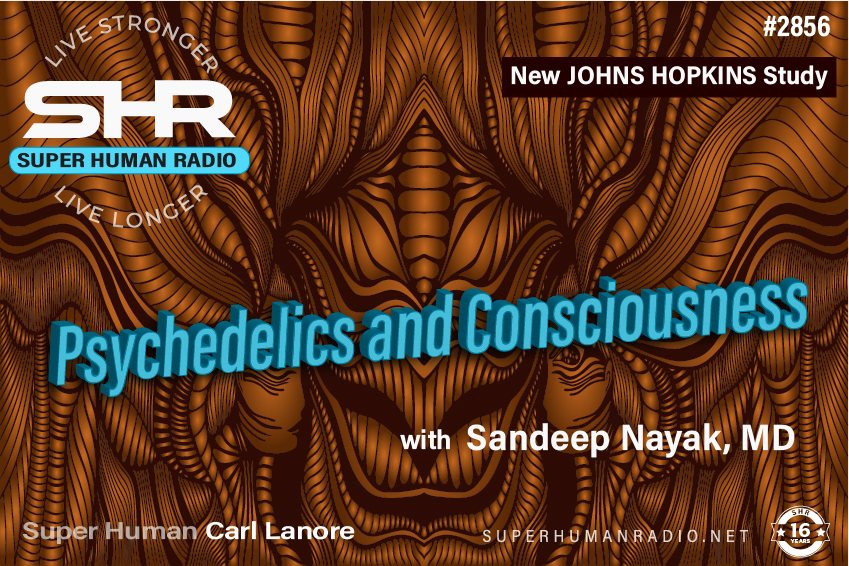
New Johns Hopkins Study: Psychedelics and Consciousness
with Dr. Sandeep Nayak, M.D.
Psychedelic drugs, like psilocybin, an ingredient found in so-called magic mushrooms, have shown promise in treating a range of addictions and mental health disorders. Yet, there’s something mysterious and almost mystical about their effects, and they are commonly believed to provide unique insights into the nature of consciousness. Now, a new study by Johns Hopkins Medicine researchers addresses the question of whether psychedelics might change the attribution of consciousness to a range of living and nonliving things.
Play
Show Notes:
New Johns Hopkins Study: Psychedelics and Consciousness
[00:03:02] What research preceded this, that made the research into the application of psychedelics in how it impacts consciousness, the next logical study to do?
- How psychedelics help people change, was of interest.
- In an overly broad sense, changing in all kinds of ways.
- One of the more striking kinds of changes that can be seen, changes to beliefs and people can have beliefs that are therapeutically relevant as well as spiritual or philosophical beliefs.
[00:02:58] The environment and context play a key role in the trajectory of the outcome and experience during and after the use of psychedelics.
[00:07:00] A use case that is being looked into is the use for psychedelics in, namely addictions of all kinds, alcohol, tobacco, and opioids. Sandeep and Carl further explain why this might be effective.
[00:11:39] A description of how the study was designed.
- It was part of a larger project looking at what types of beliefs change after psychedelics.
- 1600 People were surveyed, who had a psychedelic experience that they reported in some way change some of their beliefs.
- In this particular study the trend showed that people whose beliefs do change tends to be that they attribute conscious awareness to increased entities such as plants, fungi, even rocks.
- Attributes of conscious awareness seemed to increase.
[00:15:11] A person’s religious background can often change the content of what comes up in an episode or experience.
[00:20:04] A lot of the people that show up to these psychedelic studies, are not people who would have done this on their own. They come because they are suffering in some way. A lot of time is spent, before a person get any drug,
- getting to know them,
- building a sense of rapport and trust,
- preparing them for how to deal with the experience, which can be overwhelming and frightening.
- During the experience itself, the therapists are present the entire time .
- Days and weeks afterwards, the person is helped to process and unpack it.
- Having a negative experience in that context, is not necessarily a terrible thing, a lot of times it can actually end up being beneficial or therapeutic.
- There may be some processing that is required to turn something that is negative into something therapeutic.
[00:22:19] During the study there was no difference in outcome between genders, different drugs, or demographics. This study in particular was specifically looking at single experiences.
[00:24:20] Connectedness to nature seems to be a theme across diverse types of psychedelic experiences.
[00:25:42] Some people experience synesthesia. In other words, different senses intersect such that one sense is associated with another—a sound, a shape, a color, a taste, or a smell. Hearing music and seeing colors in your mind is an example of synesthesia. It may be that psychedelics are allowing different sensory areas that do not normally separate from each other to communicate.
[00:27:36] Carl explains why he thinks synesthesia happens during a psychedelic experience.
[00:29:00] Sandeep follows up with his understanding of synesthesia.
[00:36:00] Is there any evidence that the trajectory of neuroplasticity can also be leveraged to help somebody with i.e., Parkinson’s?
- Studies in the near future should show that psychedelics can aid in the recovery of movement after a stroke or other things like language.
[00:37:00] Do we see any changes in the peripheral nervous system or do psychedelics only affect the central nervous system?
- Most serotonin neurons are in the gut and psychedelics certainly can affect the gut.
- There are however no significant metabolic changes.
- Some psychedelics do cause nausea.
[00:42:05] What other aspects of consciousness are altered when someone has tripped once or a dozen times in their life?
- There is a clear direction that beliefs tend to move in a non-materialist direction.
- There can be very persistent increases in sense of wellbeing.
- Mindfulness can increase .
- There are things that people might learn during a psychedelic experience that they could retain.
[00:45:32] A discussion on micro dosing ensues.
[00:54:16] In the trials there were a group of people for which a regular dose did not seem to have an effect and only responded when given higher doses. It is not known that there is anybody that is immune to the effects of psychedelics.
[00:56:29] A remarkably interesting discussion on MDMA (3-4 methylenedioxymethamphetamine), a synthetic psychoactive drug with a chemical structure similar to the stimulant methamphetamine, follows.
[00:59:50] Sandeep shares the “Stoned Ape” theory, and both talk about their view on epigenetics.
[01:07:48] One last fact to share – In the study the qualities of the experience itself seemed to matter in how much people’s beliefs changed, and the energizing of emotion attaching itself to the event.
Stay in touch with us! Get show highlights, tips, new research & offers in your inbox.
Latest Episodes

SHR #3033: The Truth about Glyphosate and Disease
May 02, 2026

SHR #3032: Coming off of GLP one agonist and not putting on a bunch of fat
Apr 14, 2026
SHR #3025: Should You Fear the Fairway?
Feb 21, 2026
SHR #3031: The Sepsis Show
Feb 16, 2026
SHR #3030: Cheating Death
Feb 11, 2026

SHR #3029: The Ultimate Anabolic Steroid Research Guide
Oct 31, 2025
SHR #3028: Slow Aging. Prevent Disease.
Oct 23, 2025
SHR #3026: The Magic of Proper Stress Management
Dec 24, 2023
SHR #3023: The Prime Act - Getting the USDA Out From Your Farmers Way
Sep 19, 2023
SHR #3022: NAD, NMN and NR; Is There Something Safer?
Sep 18, 2023

SHR #3021: The Legend Of Christian Boeving
Sep 17, 2023
SHR #3020: The Sleep Talk
Sep 14, 2023