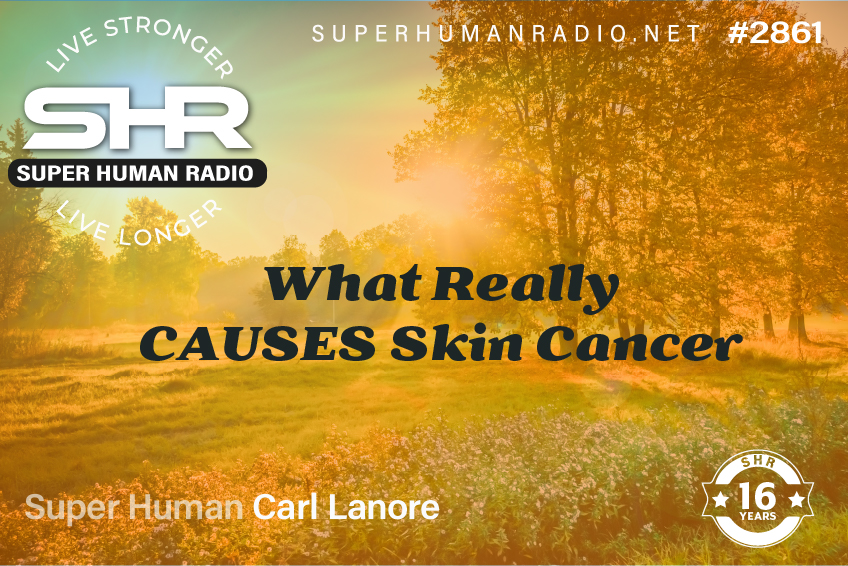
What Really CAUSES Skin Cancer
I am always astounded how people don't get the real cause of skin cancer. The sun is an unwilling participant. Even your dermatologist knows this information. But they don't talk about it with their patients. Lets connect the dots in an easy-to-follow way to what really causes skin cancer and how to avoid it if you've been told you're at risk.
From the original show date Oct. 2018, SHR # 2248
Show Notes:
What Really CAUSES Skin Cancer
[00:02:08] It is amazing how many people do not understand what actually causes skin cancer. And most of that is because the truth is being drowned out by agenda driven pharmaceuticals and the dermatological orthodoxy that promotes this notion that sun is the cause of skin cancer
[00:02:30] Explanation on the difference between causality and correlation.
[00:04:09] The sun is an unwilling participant in the development of skin cancer.
[00:04:18] The sun is only a correlation to skin cancer, so is artificial lighting and radio frequencies.
[00:06:16] Carl tells an interesting story about turmeric.
[00:10:01] We know that what we put in our mouth is deposited in every cell in our body, including our skin. There is evidence that there are things that you could consume that will protect your skin against getting skin cancer.
[00:14:44] Some profound studies done on Vitamin A (retinoid).
[00:14:58] Dr. Chris Masterjohn was one of the first people to ever talk about vitamin A and its importance. He juxtaposed it against vitamin D.
[00:15:21] Vitamin A is required for stem cell differentiation.
[00:15:56] Many studies look at retinoids in the prevention of cancer, most notably skin cancer. Retinol has a profound effect on the skin but getting it in through your skin is inappropriate from an evolutionary standpoint. It should come through your gut.
[00:16:30] Women should take 10 000 IUs of Retinyl Palmitate for their skin instead of applying Retinol topically.
[00:17:01] The correct form of Vitamin A is not toxic. The only people that have ever been killed from vitamin A toxicity, ate polar bear liver.
[00:17:47] The pathway for a Retinyl Palmitate supplement:
- It undergoes three different conversions
- It starts out as Retinol,
- then turns to Retinal,
- and then ultimately Retinoic acid.
[00:19:07] The most profound cancer preventive effects come from taking a superior quality Vitamin A supplement.
[00:19:54] Not everybody who is exposed to the sun or radio frequencies gets skin cancer and not everyone who uses sunblock is protected against skin cancer.
[00:20:12] If the sun caused skin cancer, people living by the equator would have the highest degree of skin cancer and they do not.
[00:22:30] Foods that could contribute to the production of free radicals and oxidative stress. To name but a few:
- Canola oil
- Soyabean oil
- Processed meats
- When they make these products, they render them at extremely high heats.
- Emerging research on high heat cooking of meats is showing that they produce carcinogens.
- High heat cooking denatures the meat and changes it and changes it into AGEs (advanced glycation end products).
- Alcohol
[00:29:10] People who have age spots or liver spots, those are actually AGEs getting caught in the skin.
[00:29:35] The more uncontrolled your blood sugar is the more of these age spots you will get all over your body.
[00:30:56] People who have type II diabetes have the highest risk of skin cancer. If you are pre-diabetic, you are at risk as well, because of
- Glucose,
- Insulin,
- Advanced glycation that is taking place in your skin.
[00:33:17] The cause of skin cancer is your diet; it is not the son.
[00:34:21] The first thing to consider doing, is making sure you get more real vitamin A in your diet. As well as Xanthines and Vitamin C.
[00:38:21] Some interesting information on Melanotan II.
[00:40:49] The one thing that is for sure, is that people who have no vitamin A in their skin get skin cancer and diabetics get a higher rate of skin cancer; in other words, they have crappy diets.
[00:41:00] By supplementing with carotenoids, vitamin A and vitamin C you have some protection from skin cancer.
Stay in touch with us! Get show highlights, tips, new research & offers in your inbox.
Latest Episodes
SHR #3033: The Truth about Glyphosate and Disease
May 02, 2026
SHR #3032: Coming off of GLP one agonist and not putting on a bunch of fat
Apr 14, 2026
SHR #3025: Should You Fear the Fairway?
Feb 21, 2026
SHR #3031: The Sepsis Show
Feb 16, 2026
SHR #3030: Cheating Death
Feb 11, 2026
SHR #3029: The Ultimate Anabolic Steroid Research Guide
Oct 31, 2025
SHR #3028: Slow Aging. Prevent Disease.
Oct 23, 2025
SHR #3026: The Magic of Proper Stress Management
Dec 24, 2023
SHR #3023: The Prime Act - Getting the USDA Out From Your Farmers Way
Sep 19, 2023
SHR #3022: NAD, NMN and NR; Is There Something Safer?
Sep 18, 2023
SHR #3021: The Legend Of Christian Boeving
Sep 17, 2023
SHR #3020: The Sleep Talk
Sep 14, 2023

