Adam Lamb - Dr. Jeremy Girmann
The color of the lenses of your glasses are effecting testosterone levels in men. More bad news for men exposed to the anti microbial Triclosan. This study shows that menopause causes anxiety, depression and despair in women. PLUS With the expanded use of stem cell therapy we are learning more. Practitioners are now harvesting stem cells from the patient to help fix problems. So what's new and exciting?
{mp3}https://superhumanradio.net/components/com_podcast/media/mp3s/SHR_Show_2280.mp3{title}SHR_Show_2280{end-mp3}
{spoiler spoilerID,Click to read Show Transcript,Click me to close}
[00:00:00] Welcome back to super human radio. Today is Thursday December 13th, and I am one full day post-op on my left foot and I'm getting around on a nice scooter. If you've never seen an elderly person getting around on a nice scooter. It's an [00:01:00] enchanting thing to see and that's what I'm doing right now.
[00:01:03] But I got to say it's pretty cool. It's a lot easier than crushing it everywhere, but I am. My foot I've got an elevated. So anybody listening? Eliza I have my foot elevated as I promised the doctor, I would it's not easy, but I'm doing it before we get started. I got to thank our title sponsor All-American EFX All American pharmaceutical EFX Sports.
[00:01:28] Right. Now you get six of the top-selling products. Absolutely free. What the hell you waiting for go to Superman radio dotnet. Click one of the EFX Sports banner ads put in your name and address. You will pay five dollars and change for shipping. But that's the true shipping charge and you'll get six of their top-selling products absolutely free to try so you can decide whether or not you want to buy them and that's because dr.
[00:01:48] Jeff golini believes that. Nobody should buy anything till I've tried it and unfortunately, I really screwed up because I don't have Adam's theme music Adam. Will you forgive me? [00:02:00] Forgiven. Okay. Thank you. I'd already be mad at the guy rolling around on a one legged Scooby-Doo you know what? So at first I was really depressed.
[00:02:09] I'm like is this what it's come to? Like me the leader of the Superhuman Nation kneeing it around in a parking lot at the grocery store and it's like but every come after a couple minutes of it. I thought to myself I feel like a kid again. What did wait a minute this may be actually pretty cool man.
[00:02:26] I can Buzz around on that thing. Well there, you know, that's a topic that I talk a lot on in male masculinity in the lack of play. As we get older as men in the and it leads to a lot. I believe that leads to a lot of violence anger hatred things like that, but grumpy grumpy man all day. Yeah, I'll digress but it is a little flat and last year my family and I were Atlantis in the Bahamas and are know if you've ever been there, but the property is massive.
[00:02:53] And I I'm a flat-footed and I always wear pretty good shoes, but [00:03:00] I have more flip-flops there, right? I never wear flip-flops, like I wear flip-flops like by my pool which and I walk like by P2 times and so my feet were killing me and I was like me. One of those little one-legged soon as I told my wife said next year.
[00:03:13] I think I want to briefly. Yeah put one knee on it is whip around to do it a bit fun. It's like that some downhill stuff you're cruising in so I kind of India a little bit. But you have to be in that I would prefer to not yeah, and I have no my foot. My foot was actually bleeding this morning through some of the bandages.
[00:03:33] And so this is this was a major surgery. This was major major surgery this doctor who is been doing this for 35 years. He teaches at the University here. He is considered the top foot physician in the region Sergent said to me this is the worst foot I've ever put together. She's so it's kind of sad, but you know what?
[00:03:58] I'll get through it. I'll be [00:04:00] fine. I'll walk again, you know, I'm just I'm just getting my pity party on that's all right. Now, that's all that happens. We're doing a little bit so, you know Adam. There's a lot of talk today about the color of light that gets through our eyes, right and it's like yeah, and then on one side of the fence, you got the people who say, you know, all this artificial light like me sitting in front of these two monitors right now doing this show that's like messing up.
[00:04:25] The rib necessity and circadian rhythm that my body tries to adhere to and then we move to artificially filtering light out to try to get some of the the incident light that's causing these problems out of us like past 7 p.m. Where wearing blue blockers and it weren't really works and it makes it's making more people think you know, what other colors of light when you isolate them into the eye.
[00:04:52] And saturate the eye with them what other colors stimulate other things and so this group of [00:05:00] scientists. I'm looking for this. It's let's see here Sports. It is the the lawn and last name is Lan. Dr. Londe am and this was in the sports medicine Journal. Okay, what they did was they took men? And they had them where either clear glasses.
[00:05:23] red lens glasses. and I think there was one other color that they tried him looking no. No, it was just it was just red or or clear I guess and then they did a crossover where they all did it one way and then the other they took blood levels of testosterone. They also have them doing a very very high intensity workout program.
[00:05:47] To get lactate concentrations up so they can test for that and they tested a variety of different markers in one of them that they were interested in was testosterone production during the [00:06:00] workout because we have an own testosterone level for them already and lo and behold red lens glasses reduced testosterone.
[00:06:13] And now you're an athlete. I know you're an athlete you remember back in the day the research that showed that pink made athletes less aggressive. Do you remember that? I think so, but they do it. That was football players it is yeah. Yeah. Yeah. Yeah. Yeah, I think I remember that and so when we look at this we find out that there may be a connection between a large amount of that wavelength light and I think that's in the 700s the red wavelengths.
[00:06:42] I could be wrong 700 nanometers somewhere around there, but maybe it's lower. I could be wrong. I'm not an expert at remembering the Spectrum. In nanometer, but with that being said, you know those two colors fall into the same category what they found out was that these men produce less testosterone [00:07:00] when the light incident upon their I was predominantly red.
[00:07:07] Very interesting. I wonder you know, I kind of subscribe to the thought process behind the blue light blocker. And I cut goes in phases. Basically when I remember to wear them actually last week. I know mutual friend of ours J Campbell and I were talking and he had in England on a tangent about it and I just knew I had him in my drawer to look put them on I'm going to put them to put mine on because I never I did for a long time.
[00:07:34] Where am I actually got these from GM swanwick? I'm not sure if you know he is no. He's pretty cool guys. Yes PN sportscaster back in the day, but he were human. I had some synergies. He quit drinking like I did and he has a program. He's like a 30-day program that he takes people through and I'm building out a 90-day program.
[00:07:53] So anyway, but he does he also sell these the called Swan he's and I got a pair of problem. All right. I [00:08:00] mean, I don't really know if it's better or worse and I found it being helpful for me personally. To wear something like this prior to going to bed because I was living in front of the screen my wife and I both have I but I but I have I have new concerns, right?
[00:08:15] So before we were saying there's a shift away from natural light. This is basically what we're talking about here when we talk about artificial light sources. We said we're really talking about is a shift away from what is considered natural light. So fluorescent light is not natural light incandescent light is not and what's coming out of our computers is not but how is it any different when we start to manipulate through filtration instead of exposure and radio instead of radiation.
[00:08:46] We start affecting everything through filtration. We wear different color. Like I see people wearing blue blocking glasses at work. And thinking that this is wise [00:09:00] because they've been told by some internet Guru with a bunch of mumbo-jumbo science that this is a good thing to do and it's not and the reality is you can buy and you can get an app for a dollar 99 that is a true photometer and you have tanned and you will be shocked.
[00:09:18] When you look at the incident light in your life during the day and how little of it turns out to be blue, right? We think because the screen is in front of us, you get more blue light wearing your blue. Jean pants on a sunny day. Hmm, and if you don't have blue then if you don't have blue I've tested all this stuff I've tested it.
[00:09:39] I got Ron I got Ron and Shannon Penna on to doing this and we started just testing rooms randomly bright rooms dark rooms, and it's like. Whip it we're being led astray by people want to sell us glasses now for everything. hmm. Yeah, it's very interesting. Wait. Like I said, I don't know. I don't know if I noticed a difference in doing it.
[00:09:59] Like I said, I [00:10:00] how it works but the the app, you know, I just have to believe that being in front of that stuff for your eyes and recently myself. I had a if we talked about this before but with my eyes. I think we did we talk about my eye doctor my eye doctor the study did some studying with low testosterone addiction, but also talking about the as becomes harder as your your eyesight gets worse.
[00:10:28] It causes more stress in the body which can lead to more Addiction in and I think I told you he said that farsighted men are more likely to be have issues with addiction then. Your dad is so interesting. Don't over the year already super super smart guy. And that's where I could I stumbled was past it and I told you I moved to Texas I did to take my eye test and I just blasted through the bottom line.
[00:10:53] No problem. And then she's like, what about the third problem the court threw out I didn't even see it and I kind of like it like move my [00:11:00] head a little bit and I read it. No, but man, I came home. I told my wife. Exams going on my right I checked and he said you're right. I'm at work because when you read Because I read almost every night.
[00:11:10] It was me read write as not doing anything. I was like, that's bullshit. I don't even believe I went home. I accept my left eye on like, oh man, I can't even read it was just blur but he had a problem with an address think about think about it from an evolutionary perspective for a second. I want to just I want to kind of drill down just for a second.
[00:11:28] Okay? Yeah, so. And in times where we were exposed to the elements, we lived amongst the other animals. Let's say being nearsighted or farsighted meant you were just going to get eaten younger. Right and so from an evolutionary perspective not having good Vision. I can see how that could cause an underlying ignored source.
[00:11:57] Of stress in a person's life without them actually [00:12:00] realizing it's causing it. For sure. I mean the same thing the hormones do you know it there's you know, there is a doctor friend of mine who was telling me about something actually happen to him and it in that conversation. It made me realize two of the people.
[00:12:14] I knew affected. It was a in a certain antibiotic that have to pull it up affected some issues in the inner ear. Which causes the brain to have struggle with this where it's at space type thing, you know like you're sitting at a table and you know where you're at, but the brain doesn't notice it.
[00:12:32] It doesn't know if you're following especially if you're doing something physical activity or driving in the Doctor Who had happened to and he's also a patient and into other patients similar situation and the. You were saying that antibiotics and I went to both these guys said they are backing because he had like retreating it.
[00:12:51] But all three of them were like scared to drive. They're all scared. They thought they were going to go and how it happened to me. It happened to elise's Uncle [00:13:00] John. He is a healthy strapping man in his early 80s, I believe now, but about eight years ago. He was given a regimen of antibiotics. It did something his inner ear and he can no longer stand he can drive once he gets in the car but standing and do anything like that.
[00:13:21] He has no balance anymore. He has to use a walker and people have to be, you know, fairly close by with him as well because he could easily lose his balance from a round of antibiotics. So there's a I'll try to find pull up the information in the doctor says there's a therapy protocol to help.
[00:13:39] Bring that back. But when you think of the anxiety the underlying anxiety that goes on when it's when your brain is dealing with that. Your cortisol levels are going crazy. Right and they want to treat you for anxiety all kinds of problems right when you can't figure out why am I so stressed out?
[00:13:57] Why my some nervous? Why is my resting heart rate [00:14:00] through the roof? A lot of these things are going on and it's just stuff. Like that's it that who talking and listening to patients. We have we here and fortunately because one of my patients is the doctor that also is dealing with it and listening to the patient have like man.
[00:14:16] I got two other guys, I think share this information and they all are actually going through this different protocol to help. Like kind of retrain the brain. Yes, it's super interesting. It's still rare thing, but it makes me freak out. I never know so did it so do these do these antibiotics affect the out of Konya of the ear?
[00:14:35] Is that what they effect that gives people vertigo? It must be I don't know if it's a certain bacteria that's needed that ends up getting wiped out and they said maybe the body's immune system and interesting for doesn't come back right away. Interesting. Yeah, I have it. I think I told you still one client either use the energy doctor.
[00:14:56] He's the same guy who had. I was doing the studies of how the testosterone is [00:15:00] pulling the essential amino acids out of the spine. Oh, yeah, get him down to get on to get on the show sometimes and yeah, because I'd like to explore that. I'd like to hear the reasoning behind that absolutely. Yeah, he's got plenty of stuff.
[00:15:10] So once it will get them on so you know what go ahead. I'm sorry. I was gonna say I want to take a break and I want to change it up and we're going to stay with the testosterone for a minute longer. But then later in the show, we're going to talk about something that's important as it relates to menopause.
[00:15:31] And so even if there's not a lot of women who listen to this show, there's a lot of husbands who listen to the show and I think that it'll be very valuable information in at least opening up the question. You know, should we be pursuing. Hormone replacement therapy for you. So let's take one quick commercial break.
[00:15:48] You're listening to the ReNew Life RX show. The website is ReNew Life are x.com. If you're interested in exploring anti-aging [00:16:00] and rejuvenative hormone replacement interventions. They are the people to talk to don't waste your time. I'm telling you everybody in the audience loves them loves what they can do loves to how they're helping.
[00:16:14] Loves working with them. We have a lot of new people getting on board using ReNew Life our x.com. Check it out. We'll be right back. Welcome back. Man, I got to reach a long way to get to this. Sound board with my leg propped up. Welcome back to renew life RX show here at superhuman radio network.
[00:16:40] Adam Lamb is my co-host. And he's the guy you will start with that ReNew Life are x.com if you check them out, so we do you remember all the news about triclosan about four years ago three or four years ago. They came out they said, you know triclosan was a ubiquitous [00:17:00] antimicrobial used in every single antimicrobial soap.
[00:17:03] It was used in deodorants. It was used. It was actually in Mexico. It was in Froot Loops. Don't ask me why. I guess they had a problem with microbes and and Froot Loops. It's in toothpaste. It's in mouthwash and actually in Mexico. I haven't seen it in a mouthwash here. But again, it's ubiquitous.
[00:17:26] It's out there and about four or five years ago. A lot of new research came out to show that it was a true and effective endocrine disruptor. and then and then the news followed that. Men who used deodorant with triclosan. It had a higher rate of certain heart abnormalities. They started to see changes in people's thyroid hormone levels who were exposed to triclosan.
[00:17:56] It started to poke its head as something that [00:18:00] really wasn't good and it's still out there today right now. You could probably go to a gym. And pump the hand soap on the shower stall wall and there's some triplets and that you're you know, Suds it up the guys with and so it's still out there. It's not like his though.
[00:18:16] It's all gone and we don't have to worry about it anymore. And with that the hand sanitizer peace really caught my attention because I'm kind of a. A goofball about it and I wash my hands probably more than anyone else. I know it sounds silly. It's almost like an OCD I have or I don't like it. My hands don't smell like so weird and it says if I have to eat like a sandwich or something food with my hands, right?
[00:18:39] Like I said II I'm done. I got to wash my hands, but I wonder how much I'm exposing myself to that and even my kid you have a ten-year-old, son that. No hand sanitizer if you just do or you know and see and see here's the problem with all of this. Right so it's and we'll talk about the study in just a second.
[00:18:56] But here's the problem with all this they never [00:19:00] the inherent nature of what these things do dictates that they be a certain type of molecule and that certain type of molecule always ends up being endocrine mimicking. In nature, don't ask me why it's like they BPA is bad. BPA is bad. Okay, give us time to find something new will replace it with it.
[00:19:25] They replaced it with BPS. Now. The research is coming out shown BPS is just as bad as BPA and why is that because they the nature of these molecules dictate certain inherent. Traits and characteristics and they happen to also fall into the category of things that look like hormones and our bodies.
[00:19:47] Interesting other than other than ethanol, you know, you know, you know, they had to stop using ethanol as the hand sanitizer active ingredient because dumb people was squirting the stuff in their mouths and [00:20:00] drinking it because it's basically Everclear it's you know, it's a grain alcohol. And I think that sometimes when speaking to you know clients that come on board, especially, you know, there's this guy's we talk to you that it ran some gear in the past, you know other you know that we know why they have those assessments and crazy just had never done anything and they're just like man, I keep hearing and seeing and there and and we can't figure out what led to them to have early, you know, kind of onset low testosterone.
[00:20:32] It what I tell them is it's environmentally trigger, right? We just don't know what whether it's the something in the house you live in a raisin or the chemicals that you're putting on your body or things like that and it's such an interesting topic and I don't think it's it's talked about enough as far as a lot of these outside things that are in our daily life now, that weren't.
[00:20:57] Yeah, 20 30 40 50. Yeah, and [00:21:00] the organizations that are supposed to be making sure we are protected. They they don't have the tools to make sure we are protected and unless they're RI unless they are the ones that are doing the research into the safety of this sort of stuff. You're always going to have companies out there who are going to skew research in favor of their sale of their product.
[00:21:26] And so you know it and the government can't isn't going to control that sort of stuff and we don't hear about it until things start happening, you know, the whole trick loose and thing started when factories that manufacture triclosan were having aquatic life changing right before their eyes, you know.
[00:21:44] You know certain and Fabian started to get cross gendered and it was like wait a minute what's going on here? Oh that factory that factories over there, you know, every time we have that Factory around these fish change. and that's when people started saying well what is [00:22:00] triclosan doing that it's feminizing creatures in the.
[00:22:05] And so this particular group this particular group did a study. So what they did was they took Sprague dawley rats, which is a very common rat and they expose them to triclosan in the amounts that would realistically be available in humans and then they watched what happened and they found that micro rnas change.
[00:22:31] And that change the testicles production of steroids. There are two Genesis was blunted which means any steroid made in the testes was shut down and the the changes were long-lasting even far after the exposure period And so what this says is that that triclosan is absolutely will make a guy hypogonadism.
[00:23:00] [00:23:00] Absolutely. And so I mean the hormone Pathways of rodents in the hormone Pathways of humans have really been tested. They've really been tested. We know that the things that happen to them happen to us. And so we're mammals, right? Yeah, this this stuff is out there people are washing their kids heads with it.
[00:23:23] And you know and and who's talking about it somebody needs to mention. Hey, one of the one of the things you got to start checking on your ingredient list of your cosmetics and and and mouthwash and toothpaste and anything that claims to be an antimicrobial is the presence of triclosan. That's so interesting.
[00:23:44] It's definitely something I've learned because it wasn't something I was paying attention to before so I. Love learning on the show. Yeah, and it's and you know, some of this stuff is old like like I said triclosan was a problem for five years ago. But what [00:24:00] happens is as a population, we hoo hoo hoo, but our attention span is very short very very short, you know, like they don't even we don't even remember what happened to the country ten years ago.
[00:24:11] We don't write and and so what happens is a Wanderer selective memory, I think yeah. And and people just can't keep track anymore. Just the sheer amount of information that the average brain takes in today is like ridiculous and you know and people aren't thinking about triclosan anymore because they think it will that was four years ago, right that's got to be gone by now, right that's got to be gone.
[00:24:32] Right but the buzz right especially for the average person. It's not actively investigating reading learning educating. You know, it's like how many some of you all for being article and I'm like, what do you think of the article and it is read that right headline readers and it's it's the majority unfortunately, but but you're right, you know taking the time to read into this stuff and understand the studies, you know, it's supposed to watch it my Netflix documentary [00:25:00] funded by the people that have a mission.
[00:25:02] In a certain place and then believing that's now the gospel of life and however, they should be and so I think that you know, what you do is triggering people to think and research is awesome. It has with me just done this this topic because it's not something I was super aware of. Yeah. I know and you got it you got to know Adam that it's not just trick listen.
[00:25:26] Right, so we're all like all triclosan but just like I said before there are other molecules out there that are endocrine disruptors just nobody's connected the dots yet to say. Hey, let's look at them and we're rubbing all that stuff on us, too. But I will say border this new soap from Amazon look at scalp, you know shampoo.
[00:25:46] I can come over the word and it's soaked. It kind of is a Biotene blah blah blah and scalp stuff and DHT. It was like 20 bucks whatever, you know, and there's a guy I don't ever buy to be like whatever my [00:26:00] wife had or something like that. So it's just working on a couple comments and my hair look thicker, but it really is just one of those things that just taken the time to look, you know, just something that's a little different but more natural.
[00:26:13] You know, I only use Tom's Natural Deodorant. I only let my wife use that too because I believe some of the interpersonal deodorant leads to. Issues with women to blocking the body from sweating just did logical so it's just it's just it's so that's the antithesis of what's appropriate for the body, right?
[00:26:32] It's like yeah, it's like saying, you know, you know breathing is really an inconvenience. We're going to we're going to give rub this on your lips. You'll stop breathing. It's like, yeah. No, I don't want to suffocate and I don't want to stop my pores from you know excreting. This stuff that it's supposed to excrete I'm with you on that.
[00:26:50] I use. Oh, what's it called Primal pit paste, which is basically like some natural like [00:27:00] more hardcore than my Tom's. Well, well, it's but it's but it's at the end of the day. It's just coconut oil. It's just coconut oil and fragrance fragrance oils, and that's it. That's all it is. Yeah, yeah, I understand if you're a heavy sweater you it's concerning because you got like the armpit stains towards I haven't had but there's some other stuff that leads to why you have that, you know internal look into and yeah big time and if there's people different poor stuff where I can sit in a sauna man, and I just sweat pours out of the I love it.
[00:27:33] My wife goes into a song and she looks like a sausage ready to explode shouldn't sweat as well. And so, you know, It's healthy for your body to do you know we're supposed to do that and a lot of toxins are treated that way, you know, I get an i can get this on and now because I got this stupid cast on my foot.
[00:27:52] But I mean I get in the sauna at least four times a week and it's and I get into some brutal saunas. There's a sauna at La see that you know, you [00:28:00] got to be a man to get in there because it's a hundred eighty degrees. It's a legit. It's a legitimate 180°. A lot of people can't sit in there for very long, but there's a group of us.
[00:28:10] That have been doing it for two decades over there and a group of us guys and we're all the guys it just turns out and so a lot of us would just sit in there and the sauna and we talked about everything you could imagine I've often wished. I had a microphone going because they've been some really intelligent conversations when when when the heat gets to the brain.
[00:28:30] It's like amazing. It's like it's like turbocharging your brain and we've had some amazing conversations in there that I wish I would have recorded now. Because but yeah and young guys come and go they come in they sit down for a little while and they're like out the door out the door hmm takes a little bit on what am I doing?
[00:28:50] Actually hotter than the previous Jim? I'd be curious to see I'll check out the temperature in there. I mean, it's definitely take your breath away ha. Have you ever felt [00:29:00] that I think it means him off the ice guy the guy that meditation does yoga and but I've heard about him. It's really impressive what he does stuff out.
[00:29:08] It's badass it motivated me and last year I started doing and I was just thinking about it recently because it's finally getting a little chilly here in Texas that to do I go my pools. We don't go there pull down here right in that have my hot tub and on Christmas. We were doing that and my goal what I want to do is to be able to get into my pool.
[00:29:26] It's in the 40s. It's cool, right? It's going by. Yeah, I know means it's warm. Its they they're not shiver and just kind of be able to focus my body for five minutes and I did it last year. So now it's a coming around to that time of year again, and I think it's I'm excited to do it. I'm going to start doing it every morning that's going to be a good morning ritual to just good wake up and.
[00:29:49] The parent yeah, that's awesome. That's exactly what other no coffee. You won't need no coffee. You don't need coffee. I know wake you right up at maybe it's an [00:30:00] idea pull myself off the caffeine. I love my morning coffee. No, you know what'll happen. If you do that first thing in the morning, you'll come in the house.
[00:30:06] You won't even be looking for coffee. I can guarantee you you're gonna you're gonna say it on the show next time. I'll try. Yeah, you won't even look for me. I want to take a quick commercial break when we come back. We're going to talk about something important for women. Now I know a lot of women probably don't listen to this show of you.
[00:30:22] Do I know that for sure, but the men who listen to the show need to listen hard because sometimes men need to step up and intervene stay tuned. Welcome back. This is the ReNew Life RX Show with Adam Lamb and myself and we like to talk about study a lot of stuff that we talked about it. It has a hormonal.
[00:30:48] Emphasis in nature, but that's because there's still a large population of people out there who don't understand the value of Interventional Endocrinology [00:31:00] a word that was originally coined by my good friend. Dr. Mark Gordon already for em, you know, you go to the doctor and he says your blood sugar is getting high because your body's not producing insulin enough anymore and they'll give you insulin but.
[00:31:15] If your testosterone starts to drop they don't look at it the same way they just say, you know you getting older well while I'm getting older I'm getting diabetes to why do you want to cure that but not the other one, right? And it's a it's a shell game and it's mostly because doctors don't know what to do.
[00:31:32] And that's why you need a company that specializes in this and counseling patients working with them to get them full. Treatment, you know, if you got a little high blood pressure they know what to do with it. You know it did this is not just hormones and and ReNew Life RX that cam is servicing the Superhuman Nation.
[00:31:53] I get nothing but amazing emails from guys saying I am so glad I did this and I'm telling you man never [00:32:00] before have I worked with a group that offered this type of service. Where I have the responses, I'm getting from the audience. So check them out. I so here's here's a study. That's really for the women, but you guys can pay attention to it.
[00:32:15] Right? So women really haven't been studied to the degree of menopause and it's to effects in fact up until just six or seven years ago Labs purposefully kept female rodents out of Trials. Because of that pesky hormone estrogen, you know, just she just didn't respond like the male rats so we don't want to take a chance and throw a monkey wrench into here.
[00:32:42] And so that really means that a lot of drugs that were manufactured over the past 30 years may have worked for men but not women or may have hurt women because no one cared to test so now we're seeing a lot more. Thoughtful [00:33:00] research being done into the complexity of the female hormone Cascade and disease States and it's really easy to do.
[00:33:08] Once again we go back to our Sprague dawley rats. And we take a group of female rats and we are very active mais them which is basically remove their ovaries. Give them a radical hysterectomy. They stopped producing estrogen DHE some DHEA progesterone. They stop producing just about everything and really this is what happens to your wife or your girlfriend as she gets older and.
[00:33:34] But this time they stopped and watched them for a much longer period of time, you know rodents don't live as long as humans so you can actually hyper accelerate the research and see what it would take. Let's say over an 80-year human lifespan their metabolism is faster and so they die sooner and so.
[00:33:53] They looked at these rodents and the simple answer is I'm not gonna you know, I'm purposely not getting real Technical and sciency about [00:34:00] 17 beta estradiol and all this sort of stuff because I just want you to take the message away that when women go through menopause they become more anxious more depressed and they display.
[00:34:15] The behavior of Despair their lives of just dull and aching and they are not happy and they just don't know why they're not unhappy and this is usually like when women start going through menopause is when divorces start happening too because they lose empathy because oxytocin bottoms out. They don't feel good.
[00:34:36] They have this this numb sense that their life is just miserable. They usually start drinking wine a bottle of day. Like it's no big thing. You know what I'm talking about right Adam. Oh, yeah majority is when we work with are in that either premenopausal in the process and it's it sounds it's silly and I don't even like saying it like [00:35:00] it's not that it's easy to treat but there's a lot of pretty simple things to make it better that get overlooked like crazy from what we see from.
[00:35:10] You're not always the first stop right people don't think of that. They think they're going to colleges and and even we see gynecologist endocrinologist and they bring their blood work and I'm looking at it and I'm like, the only hormone is t-shi here. We're even even as a woman. Where's your estrogen progesterone and testosterone is in my opinion the most sober has to have two women print look look ignoring.
[00:35:34] The fact that women produce testosterone is just stupid and why today we have to have people qualify the statement and explain that they think testosterone is important to it's silly like why would the medical office oxy ignore the fact that women produce testosterone? So the doctors have to be cautious about prescribing testosterone for their female patients the all the old wives tales about it's going to make you look like a [00:36:00] man and is going to make your hairy none of that happens.
[00:36:03] And women of women are excluded from benefiting from the Vitality giving effects of testosterone. Like they had when they were young girls. We see an existence as a listen to a woman share what they're going through and things like that and they tried this and looked at that and just listening. To hundreds of women share right and then seeing hundreds of women's but work and then seeing hundreds of women post therapy almost every time I tell him I bet you two stop signs and single digits.
[00:36:39] Like what does that mean? Well, we'll talk about it. Let's get your blood work done and see and then from there, you know, it's sometimes it women that on this patch and this pill and this cream and the stuff and they still feel miserable. And so yeah a lot of times we said, Let's pick some steps backwards.
[00:36:57] Thank you. Let's stop that stuff. [00:37:00] You're just a servant seems to be your lowest your low the issue because it's an upstream hormone to know a lot of those things that they're taking the the passes and pills and creams for all this other stuff that could be changed by just increasing testosterone levels.
[00:37:13] And then we start with the testosterone. How do you feel I feel perfect best. I've felt in five years great. You're not you know, you're talking 1%. 2% of what a male would take right until it's like you said the fear of like well, I don't know. What's it going to do. You're not going to get a mustache or a goatee.
[00:37:32] Now, if you're if you're going by some poor advice by somebody who may have the best experience and interest in the sense of knowledge in the lowest effective dose. You could get those side effects, right? Because we see and know women I'm sure that have had those of side effects. Sometime they have some you know, what, you know, you know what I mean?
[00:37:56] You know what I say Adam some women just need less. [00:38:00] So the idea that you know, what you do is you give give a woman a dose of testosterone if it's in a trochee, you know, maybe a couple three milligrams maybe four milligrams, right and you want and you watch her blood and if it goes up and she says, I feel great.
[00:38:17] Okay, let's just leave it there if it goes up and she says. I don't feel good. Then. You've got a lower it if it doesn't go if it goes up and she says I still don't feel good. You got to raise it the idea, you know, it's hard if people understood the time to get a complete blood panel done is when you're 30 31 years old because this is the mature side.
[00:38:45] The beginning of the mature side, but your body is still in great repair and then you have a time capsule. So when you are 50 and 60 instead of them throwing darts. And trying to hit what's good for you and in this hormone at home and you can [00:39:00] see this is what I look like when I was still vital and young enough but mature enough, you know, everything kind of settled in I'm this is who I am moving forward and they go.
[00:39:09] Oh, wow, you know you you had really high testosterone levels. That's that's interesting. I wouldn't have thought that you know we but unfortunately we are relegated to guessing today because nobody in the medical author talks. He talks about the proactive steps of. In your child hormones tested now that could be the potential greatest gift.
[00:39:31] You could give to your child ever really happens. You know, I think that I remember growing up or they're just kind of like the short kid for lack of a better description that maybe had a, you know, onset adolescent growth deficiency and they got unreal promo, right? And that's the only time it seems like it's something like that was looked at.
[00:39:51] And it and it makes me think, you know, we talked about a couple weeks ago. I'm going to do it my son. He's 10 years old athletic, but when he gets into that [00:40:00] even early 20s were going to look you know, and probably even once a year and a lot of times, you know, I think the two often doctors least request blood work and they're like, well, what's wrong?
[00:40:11] Like maybe nothing. Let's see, you know and looking at it. My mom recently had a scare with some things and fortunately we looked at her blood work prior to her find out about this gear which leads to the scarce. Probably not that bad because it bloodwork didn't reflect. It should help people at work, but she asked me not to I'm not going to go into.
[00:40:31] And so I think that looking at blood work is just it's one of those things. It's not very expensive and it just makes a lot of sense. I mean so many diseases or stage fours and those kind of things severe stuff could have potentially been seen through blood work or at least triggered that that next layer of testing, right and that needs to be done more on this topic.
[00:40:54] It's ironic that we're talking about women. I just received an email from a woman. She's a. She'd be a [00:41:00] well-known retired competitive athlete who competed at a high level. She's a bigger and bigger projects Tom for that but she's probably a hundred eighty pounds. So I would say it's not a little woman to it.
[00:41:12] So we understand we're talking about and I say that I share that because of dosing and she's she's just doing she we we recently increased the dose because she's just wasn't quite there and now it's normalized. Her menstrual cycles normal and cheese their late forties and she's like finally this is where she needs to be before.
[00:41:36] He was receiving we still talking about just testosterone or would you giving her this is just too fast for ya. I'd see you have here doing too much testosterone with with folks in run out there doing and then after that she went to a guy I know who's. Not even really just a drop in the bucket compared to her body needed because she also took some things in the past to alter [00:42:00] her testosterone and you got and that's and that's something you got to be honest with about with your physician.
[00:42:06] And that means you have to be talking to someone that you feel comfortable being honest with you know, one of the biggest challenges that guys have talking to their doctors about testosterone is is they feel like is though. They're being going to be vilified or thought of you know, I mean, I've had these experiences we've all had these experiences where a doctor misconstrued something and like right away looked at you like you're some sort of.
[00:42:37] You know drug using illegal drug using you know, it's like you can't do that. You can't do that. You have to you cannot be judgmental if somebody comes in and says look, I was an athlete and for seven years. I was on fairly high dose of testosterone. Do you got to go? Okay. What else are we up against?
[00:42:55] You know, like that's it. You can't judge people and that's why [00:43:00] more men and women aren't on HRT today in my humble opinion because they don't want to have that first conversation. And like you mentioned earlier and I think that your point out now, that's one of the biggest things about our Clinic is we create that space where I'm like stupid like I'm your bro, like what grunts let's talk in we talked about your life and life experiences and lifestyle how you eat or those kind of things and just like get to know the people and I'm sure that you've got received a lot of that feedback from folks have come over and that I personally got a chance to work with.
[00:43:32] And it's important and it there's another imagine strategic today that I want to share with you because it hits exactly what you're saying. This is right a little tea Clinic. He says, hey dude talk. This is the kind of stuff. I couldn't talk to you with the girls at the charity Clinic. He starts to stop some cream.
[00:43:47] We switched him he was doing. Once a week just ask her injections and his blood work. He was jacked up but it's the sauce from is okay and they weren't treating shbg or anything like that. So anyway, he came over. He said [00:44:00] this cream treatment seems to keep my libido at the high sensation level.
[00:44:04] He's even said is it normal for your penis to be more full? Because you know, sorry to be graphic. He's like, you know, I can't I feel I can talk to you about this kind of stuff. He's like is it normal could talk about this to these girls, right? He was using at the world. Yeah, I know to your point of just saying it like we create that environment in a lot of times.
[00:44:24] I know that even if we work with Physicians and they know they're like man get that white coat that cold dry office. They people don't want to share they and that's where like our medical director and other positions. Love this because. We can have it conversation is just like two guys right. I'm I'm like, you know, I'm going to be 39 and you're 42 like kid's life but we're in that same space and then we related that stuff to the doctor and have those conversations and our doctor.
[00:44:53] See we're having those conversations pull out some things that we can understand, you know, but you know what to do. You know what the [00:45:00] difference is. I'll tell you what the differences and I when I say this I'm telling you unabashedly. This is the difference, you know, the. Average person wants to have the conversation with the doctor.
[00:45:11] The doctor doesn't want to have the conversation with the patient and they make that very clear through posturing and body language and and shortness of questions asked and and and then delegating to the nurse to enter this stuff in the computer and darting out of the room and then coming back and breaking up the conversation.
[00:45:32] Anybody who's been in a doctor's office knows what I'm talking about. Your doctor doesn't want to know. They when you tell them anything outside the nine dots like they have these arrows in their quiver. And as long as it's one of those things they got an answer and if you ask them anything that requires them to actually formulate a a long formatted answer to you and actually have to dig back in their brain and assemble some thoughts and give you something [00:46:00] new that they haven't said for the past hour.
[00:46:02] That slows them down. They don't want to do that. So doctors today, they come in and say hey how you doing the shake and what's you know, what's going on? They listen for a couple seconds and then they start writing and the next thing you know, they're done and they and their body language doesn't invite.
[00:46:20] Doesn't invite people to go, you know, doc. I'd really like to talk to you about something because you feel like this guy is just pushing me off. This gal is just rushing through this like they really are not interested in anything and I'm not going to try I'm not even gonna try and that's sad today, but that's what medicine has become and it's not the doctors fault.
[00:46:40] It's not the doctors fault the doctors don't become doctors so that they can rush through patients all day long. It's the system it's the system but. It is the problem. It is the problem. It's a great point that you bring up at not in a pressure this me a little bit, but for me personally, I usually get.
[00:46:59] Higher, I don't [00:47:00] get it. I I know what happens. I don't see it. Usually when I see my primary care when my other position they're like on their toes like what's he going to come at me with it fire up Google but we don't I've been fortunate to have some really awesome primary carers and even my surgeon recently with my dad keep he was like he wants to know the whole protocol for the recovery from peptides and he wants to get into the stem cell stuff for the issue is can we're going to be talking about tool going to talk about next to this guy doctor.
[00:47:28] Me Germann, right? Ron penny guy that everybody knows I have a lot of love and respect for tells me about this guy a long time ago and then a couple things happen and somebody said, you know, you should have dr. Gorman on the show. He's doing a lot of exciting stuff with stem cell, you know stem cell is come a long way and there are some doctors not to use an overused analogy on the tip of the spear.
[00:47:57] That are doing some amazing stuff that a really [00:48:00] applying critical thinking to the application of stem cells and mediums that support stem cell proliferation and growth and differentiation and so on. That know stuff that we need to start talking about. We're actually going to talk to him in just a minute at after this interview is over but this guy is I'm really excited to have this guy on the show and any trains so you got to have a lot of respect from the guys got an amazing physique.
[00:48:31] He's like, he's like movie star handsome. He's like you. Your movie starring about that. Oh you are. Yeah, I'll come on. You know, you did my bed. Dude. You handsome guy. Are you you're kidding right now right take the compliment. Look if I was here, I'm going to tell her to run with it. If I was handsome when somebody told me I was handsome I'd say okay, I appreciate that.
[00:48:53] I get to work with a lot of handsome. Like literally legit TV kollywood guys and you know, my wife [00:49:00] knows who I was the darkest. She's they call, you know, we're friends anyway to and so I'm going to I'm going to joke with her a little bit about that. So I appreciate you saying that the crop call said I'm movie star handsome to just a couple of other guys.
[00:49:13] Yeah, no, you definitely are the I see pictures of you all the time. You you're you you're a you're a well formed human being. So what I'm going to do is I gotta I gotta take a break and then I got to come back with dr. Gorman and I gotta do something about my leg because sitting in this half plie is a time.
[00:49:35] So all I do is pistol squats now on my right leg every time I got to get out of a chair. I do a pistol squat. You have one big quad. Yeah one big quad. But anyway, I will come I'm going to bounce out of this. I am going to be better than I was before and I'm scared because that's a big big. Peace to bite off right now with what's going on with my body, but I will do it.
[00:49:56] I listened the website is ReNew Life [00:50:00] are x.com. You must go there. You must talk to people you must learn even if it's just a fact-finding mission. You say I'm not going to do this, but I just like to see what all the hubbub is about. Give them a call talk to Adam. Learn we love, you know, just come in and say that you heard about the show and you a hundred percent have my undivided attention to schedule call just to talk and ask questions and I love that.
[00:50:25] Yeah, that's what I got into the base for and don't wear red sunglasses. Unless you want you to start on drop by Adam. Talk to you soon, brother. Take care. Thank you. Hi, we'll be right back with dr. Jeremy German and it's going to be exciting statement. Welcome.
[00:50:46] We don't know enough about stem cells yet and really the more the number of people who are critical thinkers thought looking at the applications leveraging some of the interesting mediums [00:51:00] that seemed to create a fertile. Territory for stem cells to do their job are in need because there's a lot of snake oil sales people out in the stem cell world to I've you know, I haven't done a show on stem cells in quite a while just because some of its murky, you know, some of it is almost Carney ish like like circus stuff, you know, people are going on video and getting stem cells injected and what is it supposed to do and nobody knows.
[00:51:30] but. Dr. Jeremy gehrman, did I pronounce your name as a dearman? Yeah, you gotta Carly. Yeah. Okay. Thanks. I'm a I'm a big stickler by pronouncing names, right? Dr. Jeremy gehrman is doing some really exciting stuff that has been touted to me by people who I respect. And I know these people aren't going to talk about a guy who is one of those sides stage shows that's going on right now.
[00:51:56] So tell me something. Dr. Bierman. I'm gonna refer [00:52:00] to as dr. Bierman out of respect of the show. How did you get started working with stem cells? Well Carl, first of all, I appreciate you having me on the show. I really respect what you do and the variety of topics that you cover in the the depth at which you cover them and I've referred.
[00:52:15] So many of my patients and colleagues to your show because you just do a great job. So I appreciate that. But thank you. Yeah, so this is a neat opportunity and you know as far as how I got involved with stem cell therapy and really more generally regenerative medicine. I think was just an evolution of you know, my course medical training and then on to practice where you know, we just look at what treatment options are available to us today and I think early on even in my medical training and perhaps even before that.
[00:52:46] I kind of saw the writing on the wall in that you know, more of medicine was moving towards less invasive more regenerative leveraging the body's ability to heal and I guess some of that is my background and the sense that I have somewhat of [00:53:00] a Fitness and Nutrition background and really had an appreciation for what that could do for a physiology and I really kind of recognize the unfortunate nature of a lot of modern medicine just seeming to be.
[00:53:13] More sort of high-tech Band-Aids without ever really addressing the foundational, you know kind of rudiments of health. So it was just an evolution and I always had such an intense interest in musculoskeletal medicine particularly and while stem cell therapy and other regenerative therapy certainly extend to really every organ system.
[00:53:31] I've kind of honed in on the particular application to. The musculoskeletal system that being muscles joints tendons Etc. And you know when I got into practice I just said what do I have available for my patients and I think more and more patients are becoming increasingly interested in non-surgical Solutions.
[00:53:50] And and really they're looking to stay ahead of their health and that's kind of I know what your show is all about, but really being up on what's out there and how do we optimize our physiology in our [00:54:00] health rather than. You know treat when it when it's too late and so we're really an exciting time in medicine and I've really kind of made it a goal of mine.
[00:54:11] I feel the responsibility essentially to keep up with the literature and to figure out where things are going and how we can leverage some of these new exciting Technologies to offer additional treatment options to our patients and we're going to get deeper into that in a second. But but I want to ask you a question that I've always thought of.
[00:54:29] I have a feeling it's something that is crossed your mind more than once and that is we have stem cells as part of a maintenance and repair system inherent in our bodies and stem cell therapy leverages concentrating them into areas that have become in disrepair for so long that that that normal maintenance would not fix anything.
[00:54:56] Right. Why why are we not leveraging the stem cells that we [00:55:00] have naturally in our body that are designed to maintain the body over long periods of time so that complete disrepair doesn't happen what's lacking in our environment and our diet and our way of life that is stopping that natural phenomenon where we have to go in and we have to suck them out and shoot him in over here.
[00:55:22] We know that's a great question. And I think that a lot of it comes down to exactly you mentioned which is dietary environmental influences. All that sort of thing. Now some of it's just a natural consequence of Aging in so much as and I'll get into the different sources of stem cells and particularly those that are utilized in the clinic.
[00:55:39] But if we take the example of the stem cells and particularly. Uncle Mo stem cells which will talk more about the reside in our bone marrow there's a dr. Arne Kaplan out of Case Western University who published a chart essentially demonstrating the trend. Decline over over our lifetime and there's really a precipitous decline [00:56:00] is a tenfold declined from the time where newborns to teenagers and then another tenfold from the time where teenagers to older age.
[00:56:06] And so some of it's a consequence of just aging whereby some of these stem like cells become quite yes, n't sort of sleeping and you will some of them actually died in certain tissues. They remain more robust and the population. Are greater but you know, I actually wrote an article about this and it's kind of what are the dietary and lifestyle things that we can do to help support our stem cell populations.
[00:56:32] There have been studies out there looking at different dietary constituents different chemicals found in blueberries melatonin, all these different sorts of things, but the bottom line the way I ended that article was by saying that okay here we have melatonin here. We have this chemical that chemical but a lot of it comes down to just healthy lifestyle things, you know translated to me too good.
[00:56:52] Bleep stress reduction great diet, you know high in micronutrients and all that sort of thing. So I stress stress [00:57:00] reduction is a huge thing and we have not conquered it yet. And that's right. It's a really big thing and we just it's one of those things like, okay. Well, we'll get to that later. We got all this really important stuff first handle and when missing the boat on the the effects the degradation on The Human Condition by stress and we manufacture stress purposefully because it's entertainment.
[00:57:22] Something occurred so it's like we really like if we are like moving so fast towards idiocracy and wildly like it's just like those someday like a million years from now people going to find those they going to think those were our Bibles because we actually became exactly all the things in those movies but isn't his art.
[00:57:41] Yeah. It is. It's sad it's very sad. So so, you know getting back to this stem cell do you think. Therapeutic phlebotomy has a value in unleashing mesenchymal stem cells from the bone marrow. Well, let me back [00:58:00] up just a step if you don't mind because there is there. You know, I appreciate the way you introduced the show, which or at least my segment in that there's a lot of nonsensical claims being made a lot of misinformation and I got to tell you it's really frustrating being a provider who tries to keep up with the most relevant and current literature because you see a lot of that and you know, some of it stems from the excitement around this area of regenerative medicine and some of it is just, you know, these practices trying to differentiate themselves and.
[00:58:26] More patients clients. Yeah, what have you and you know, I guess big picture one of the things I hear a lot of one of the ways in which I hear a lot of misinformation being disseminated is about you know, what exactly are we talking about here? So when we talk about stem cells. There are of course many types of stem cells in our bodies each, you know, there are cardiac stem cells.
[00:58:50] There are stem cells in our GI tract, but the big class is here. They can be categorized based on their behavior. So the type that a lot of people think of [00:59:00] and you know, I'll tell you I even get some patients calling my clinics and are we talking about dead babies here? And there's a lot of concerns.
[00:59:06] You know and I understand why especially, you know, God Rest his soul but when George Bush Senior was in office, there was a lot of discussion about this a lot of Regulation and that's specifically related to embryologic stem cells. So those are the type that are derived from the embryo that are really only present during that developmental stage.
[00:59:24] And those are what are called and this is important. Those are what are called pluripotent stem cells. So those can become really any tissue type in the body because ultimately their face had become babies. They want to be growing two babies. And so we're talking talking apples and oranges here.
[00:59:39] Now the type that are being leveraged and utilize in clinical settings and particularly those like mine arm is nkomo stem cells. And again, they're very very different. Those are technically considered adult stem cells there an all of our bodies are in mind yours and a baby's. And those were first kind of discovered describe named by that [01:00:00] that that doctor that I mentioned before that researcher.
[01:00:03] Dr. Arne Kaplan out of Case Western. He named them describe them and and they can be derived from one of several places one in many places. Actually. They're also known as parasites Perry means around they wrap around blood vessels. So it's really cool if you Google mesenchymal stem cells. Blood vessels or even parasites you'll see these electron microscopy pictures of these cells hugging blood vessels and that's exactly that's where they reside and so they can interact with the environment by secreting signals into the blood vessels that they surround or by traveling to sites of injury through those blood vessels.
[01:00:44] So so wait, but they're on the outside of the blood vessels. So you say they can travel to sites of injury through the blood vessel. So do they. They infiltrate the blood vessel and then join in with the blood and travel Upstream. Yeah, that's right. And that's really how A lot of think about that for a second because they have to know [01:01:00] what Upstream is, right?
[01:01:01] Yeah, like there's got to be some sort of. Proprioceptive quality to know hey, we need to go further left. Like, you know, that's pretty cool. Well, I'll tell you that whole mechanism is what's been home to or termed as the Homing mechanism sort of like homing pigeons. Yeah. There was a really elegant study where they looked at rats and they took two groups of rats and one group had no surgery the other group had a sternotomy really like a chest surgery and they injected mizenko stem cells into the tail vein kind of like the jugular of these rats.
[01:01:34] And then they they immunofluorescence T cells they could see after they took a picture where the cells go in the group that had not had the surgery they kind of went all over but the group who had had this door NADA me all the cells essentially collected right around that wound bed. Wow, so that's that's one of the ways in which they function but.
[01:01:51] You know coming back to the idea of them being located around blood vessels because that's so we can derive these cells from really I need [01:02:00] tissue that's dense and vasculature. So some easily accessible sites are bone marrow our fat tissue or even donated tissue known as a low graphs like from placental tissue and these are from.
[01:02:13] Consenting mothers who donate otherwise discarded tissue like the placenta the umbilical cord at cetera. So the cells can be derived from these different places and then use therapeutically in in my case. What I do is musculoskeletal treatment of arthritis and pain and problems and that sort of thing for really palliation of a lot of the symptoms associated with this conditions and and hopefully for some regenerative qualities and so I would imagine most of the work.
[01:02:41] Is being derived from pulling it from the pelvis, right? I mean, what you do is you you extract a person's own stem cells, right you spin them right? You concentrate them. Could you put him back in a medium that maybe is he, you [01:03:00] know, some people using PRP type medium. Some people are using growth factors peptides that are injected directly into like synovial capsules to keep everything.
[01:03:11] And you create it's like it's like a guard you got your like a gardener now, right you like you're planting something but you got to feed the soil and you got to give the consideration for this and that because otherwise it just dies. It doesn't work, right? Yeah, and you know, this is where a lot of the nuances of regenerative medicine come into play Because when it comes down to it, you're right when we when we talk about bone marrow aspiration most commonly, you know, I'll perform that from the iliac crest which is kind of that hip bone that waist bone.
[01:03:41] You can also get it from you know, the sternum and the tibia and those are more so done intraoperatively in the setting of an orthopedic surgery. But yeah, you aspirate bone marrow and then you spin it down and you try to try to isolate the cellular layer and then you would inject that into an e for example in the case of an [01:04:00] arthritic or otherwise damaged knee and then what you get is a release of growth factors from the cellular contents signaling molecules cytokines and you know, and also you get a lot of scaffolding proteins and other sort of tissue constituents that are present in the bone marrow that.
[01:04:18] Tribute to tissue health and regeneration and and before I forget another really important Point here is that the the man who kind of named these mizenko most stem cells has actually since petitioned the FDA and others to change the name to Medicinal signaling cells and that's a really important point because it seems as if that's the primary way in which these cells work therapeutically.
[01:04:45] So once injected or delivered to a tissue site. They release a number of these medicinal chemicals medicinal signals that then set up the body's ability to engage and accelerated healing and repair and so, you know, one of the [01:05:00] criteria for stem cells as was listed by the international Society of cellular therapy and particular one of the defining characteristics of mizenko stem cells.
[01:05:11] Was that they have to be able to differentiate and in the case of MSC? Is there a abbreviated they can differentiate into osteoblasts which are bone cells adipocytes with your fat cells chondroblasts order which are cartilage cells, but these can be coaxed to do so in vitro, which means in the lab but in the body.
[01:05:34] We don't know yet. If this is necessarily occurring especially the numbers or the way in which it's been doing and the way in which this is being done in the United States. And so where is in the lab again, we can coax these cells to do this in the body. We think that they're primarily signaling sort of acting as the conductors of the orchestra the healing Orchestra so to speak and so that's where a lot of this is still being worked out how [01:06:00] much of this is actually.
[01:06:01] A signaling process, you know, if if that's the primary mode of action which signals are having the greatest effect. And then if these cells do in fact have this ability to differentiate into these different cellular lineages as is demonstrated in the lab how much of that is occurring in the body.
[01:06:19] And so a lot of that is still being worked out and there a reason you suspect you suspect it's happening at a similar rate or do you suspect. That is happening and happening at a much lower rate. I think it's a much lower rate, but I'll tell you what, you know, it's a tough study to do and I won't go into the details of that but one of the reasons that it's difficult to look at this primarily through the means that are being utilized here in the states is because we are confined by the regulations of the FDA and there's a branch of the FDA known as cyber the center for biologics evaluation and research and they.
[01:06:57] Said they're trying to kind of you know, the [01:07:00] commissioner of the FDA is a cellular Advocate but they're trying to kind of rope in a lot of this because of what you mentioned before there are a lot of bad players in the game and we want to make sure people are safe and we have some reason about this and so they've.
[01:07:12] Kind of set some regulations and they said that you know, number one in order for these type of tissues to be used. They're regulated in a certain way and I won't necessarily go into that but it's called a 360 one pathway. They have to be minimally manipulated. So in other words, we're taking tissue out we're spending it which really doesn't change the the original kind of relevant characteristics of the tissue or the cells or what have you and then rejecting or treating and what have you where is.
[01:07:42] In other countries, what they can do is they can take these cells take them into the lab incubate them and culturally expand them over a week two weeks and now 10 million cells turns into a hundred million cells. And so the implications of that now if we inject a hundred million [01:08:00] cells we may in fact have kind of surpassed the threshold where we start to get some of the cellular conversion or differentiation into other cell types.
[01:08:08] So I just don't know so what you're saying is. That could actually produce some Rogue tissue that you don't want to happen when you just kind of when you blasting that much into. Well, we haven't seen that so much more. So what I was referring to his day, I would think that in that setting perhaps we can get a differentiation of these msc's into their natural lineages which would be cartilage cells and that sort of thing and there are some studies for example out of Korea and other places where a lot of these investigations are being done that show pre and post card radiologic studies that show cartilage thickening cartilage growth cartilage defects.
[01:08:47] So the most sold so the bottom line. In this case more is better. Well, we know that's kind of that's a that's a tough thing to entirely agree with because we just don't know there's some other suggestion [01:09:00] that perhaps if we expand sells out to a certain point and keep growing and growing perhaps they sort of become I guess their effect is somewhat diluted so they become a little bit less effective or less potent if you will, so we're still trying to determine all of that.
[01:09:14] I wonder I wonder what the limiting factor is. I bet you're someone's going to discover the limiting factor and. Can then you'll be able to go Hog Wild and put a lot more cells in there. There's got to be a limiting factor is got to be an erosion of something that that keeps them from going on in this Positive Growth Direction.
[01:09:33] I bet I'll bet I think you're right about that. I want to take a quick commercial break if we want to pick this up and finish up on this on the other side. We can we're talking today with. Dr. Jeremy German about stem cells the lot going on a lot to learn. We're going to talk about some scams to when we come back.
[01:09:50] Stay tuned. Welcome back we're talking with. Dr. Jeremy German were talking about stem cell. I did I cut you off to take a break. Did you want to [01:10:00] finish up on anything on the from the other side? Well, I guess it just a couple of more a couple of additional important points is that number one, you know, there's a lot of talk about specifically the stem cells which and for good reason.
[01:10:13] I mean they hold a lot of therapeutic promise. But you know, we're still working out all the details related to Stem Cell Therapy and how many are needed and and you know exactly how should they be delivering all that sort of thing, but I think often times the growth factors that I was referring to before our underappreciated because there have been studies done in the in the world of regenerative medicine using the condition media.
[01:10:40] So in other. Some of the soup in which cells were growing and and and living and that that media was used to treat different areas with similar outcomes. And so just just the media that happened to be in contact with the stem cell. Yeah. And so I use some other products in my clinic also and this is kind of the art of medicine determining [01:11:00] which patient or which treatment is most appropriate for which patient but you know, actually I just got a call from one of my patients about an hour ago, which is a very timely call but he's someone.
[01:11:09] And whom we had treated a partial rotator cuff tear with an amniotic membrane allograft. So basically this is the these are the outer layers of the placenta which are sterilized and dehydrated and really don't have any living cells in them. It's just growth factors and healing. And it encourages the body's the migration of the body's own stem cells to the site of injury as well as a laying down of collagen and all this sort of thing.
[01:11:34] And so he called me just say I've been thinking about calling you for the past month we treat about six months ago. He said my shoulders never been better. He said I'm so pleased by this and it was really a neat case where we under ultrasound guidance injected his partial rotator cuff tear in lathe.
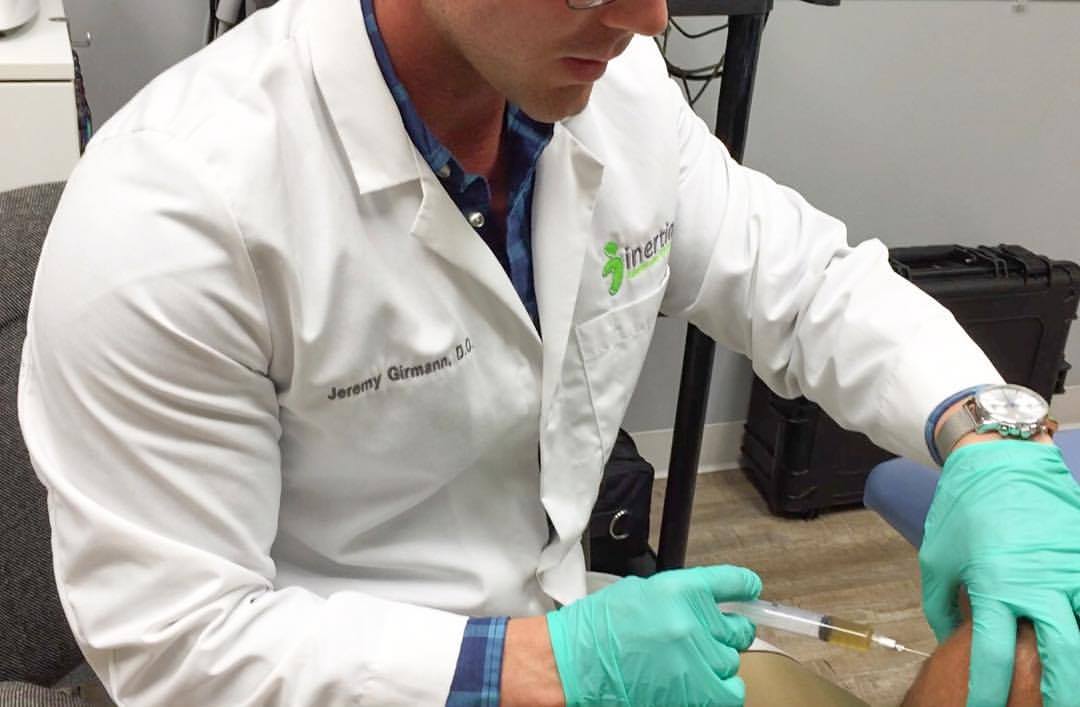
[01:11:51] Allograft right in that defect which is related in there with a syringe I'm taking was it syringe, you know, I was just looking back because for his sake [01:12:00] I was kind of trying to figure out exactly what she did we did that and I put it a lot of these these cases, you know, without patient names, of course and information on our Clinic Instagram page at inertia medical and on July 6.
[01:12:13] I posted his video. Where we have on Roshan guidance, we have the needle injecting into the tendon defect which can readily be appreciated. So it's pretty cool. And and that is then another important Point here, which is that. You know, I hear a lot of patients saying well I went to this clinic and they said that they were going to just you know, inject right into my shoulder and you always want to go to someone who uses guidance.
[01:12:35] Oh, yeah, you got to have ultrasound guidance through that Prada have got and you know, the literature shows that if we're talking about a shoulder, I mean for for eons, we've been injecting with an atomic guidance, which means just kind of well sending me here suddenly there and and there's your entry point turns out it's about 40 percent accurate in the shoulder without Guidance with ultrasound Encino 99 you.
[01:12:55] Exact where you're going so that's that's another big deal and [01:13:00] you know and just making sure if this is a type of therapy that you're considering. I had another patient in my office the other day who said, you know, I went to this Clinic they said you got to try to Stem Cell thing we can do it today.
[01:13:10] And you know, I evaluate he said I just didn't get the right feeling and I evaluated and get a complete retracted massive rotator cuff tear for which stem cells really wouldn't have offered a whole lot because. That's scaffolding the the stem cells and you know, the the the rest of the regenerate material would have been able to sort of cling to for lack of a better term and supplement and regenerate it was absent, you know, it's kind of like, you know a bridge that's falling between two rows.
[01:13:38] There's nothing there's nothing to connect anymore. That's right. That's right. Right. So, you know you proper evaluation and proper guided treatment is critical. So what about these clinics that offer? Stem cell therapies and a lot of times it's like in Panama. Yeah, what they do is they take. [01:14:00] I guess the mesenchymal stem cells they inject them intravenously and and these stem cells are supposed to go around your body like these little heat sink seeking missiles.
[01:14:14] And they see damage and they go right in there and then they fix it. So the people are promoting this idea that yeah, you know, we're just going to infuse stem cells into your bloodstream. They're going to travel around. They just got to stop fixing. Yeah, well, I'll tell you that in Panama specifically and there are several like it but Neil reardon's Clinic to Stem Cell Institute in Panama.
[01:14:34] They do a lot of that and and that's an example where he's not restricted by the confines of the you know, what you think there's any value to because think about what you said before about about the the rats that didn't have the surgery, you know, the stem cells just kind of floated around. Well, what if they saw something else that was like wearing out and they won't go there.
[01:14:55] I think there's a lot of promise there is. Really do and we're starting to see that in the literature. Now [01:15:00] again, all of this becomes a little bit nuanced because for example, some of the investigations have shown that when you inject stem cells peripherally into a vein about 90% of them get sequestered in the lung tissue and then are kind of out of the body within the day.
[01:15:14] Yeah, so. And you know, does that have important implications for for pulmonary disease? And then okay the signals that are released within that 24 hours are those able to reach so there's there are a lot of unanswered questions. But but to kind of come back to the the the appointing the initial question you you're seeing exactly that people are saying come into our Clinic get injected, you know will treat Parkinson's you know, and that's all these different things and that's so premature and really irresponsible, right, you know, but.
[01:15:43] That's not to say that these therapies don't hold immense promise. Right? I mean, they literally could work. Yes, but but a lot of rigorous science has to be invested to understand how to work. Yep. And you're right and a lot of people taking [01:16:00] advantage, you know, one of the reasons I've guy did a show on stem cell therapy not too long ago.
[01:16:05] Where a friend of the show from Ohio also from your state. Dr. William see. Had done. He extracted stem cells from his wife Jocelyn's pelvis and then injected into a Troublesome hip that she's had for some time and and you know, so we've done we've done that show from a standpoint of the patient.
[01:16:27] How did it feel? What did it feel like having are just you know, the pressure of that on your pelvis as though cuz I wanted to explore that side of it because I know that people are reluctant to do anything that they think might hurt. That's why dentists have such a hard time setting up. Yeah.
[01:16:40] Yeah. Well as it applies to a bone marrow Harvest or aspiration you we numb really well, we numb all the subcutaneous tissue down to the the the Bony cortex are kind of outer layer and then you introduce a little trocar and there is pressure and a lot of its related to the pressure change that [01:17:00] occurs when you access that bone marrow the pressure between the environment the bone marrow sort of equalizes and so they get this weird kind of intense pressure and if you don't warn them, it's a surprise but.
[01:17:11] That's one option. But as I mentioned before since the MSC populations decline as we age we think maybe it's not as great not right for folks who are maybe over the age of 55 or 60 and then you can also get these msc's from fat tissue and those populations seem to stay more. Consistent over time twisting mini liposuction type of procedure.
[01:17:33] It's a very kind of small procedure or you can use allografts which are from that donated tissue. Now, there's some question about what's the viability of all these cells and these allografts come cryopreserve and when you saw them, what is the nature and we're working currently with a lab on that comparing the cell viability between the different products, but the bottom line is.
[01:17:52] Is it came back to me for a lot of the effects are being in infer by these treatments are from the growth factors and from [01:18:00] some of the healing chemicals that are in these products. And so we don't know how much of it is from the cellular material how much is from the growth factors? And I kind of give people the example of the reason why this is so hard to study one of the reasons.
[01:18:11] Well, I'll give you two one is that the product that I take from you is going to be different from the product to take for myself or can compare that both of us, you know exercise eat. That sort of thing to someone who is 75 smokes like a chimney is that has an extension so you don't you don't even want those stem cells back.
[01:18:28] Hey, you don't want those bright. Hey Doc. Can you get those out of me? I don't want those. Yeah. Well, you know in the other issue is that I tell people all the time. This is so hard to study because in scientific literature we kind of operate. This concert is scientific reductionism. We it's it's it's much easier to study One Drug one chemical without ladies confounding variables and we're talking about a biologic here.
[01:18:51] So I tell people it's like kale, you know, is is it the fiber that's good for is it the vitamin this is the vitamin the answer is probably all of it and it's the same thing with the biologic [01:19:00] treatment. There's so many. Signals and molecules involved in so teasing that out from a scientific standpoint is very very difficult, which is why we've sort of been I had some difficulty progressing the field to this point.
[01:19:12] I want to take a commercial break and when we come back when I want to talk about is some of the things that are used to enhance the success of stem cell therapies, even maybe some vitamins like like retinol vitamin A. I know that it plays a role in differentiation. And do you focus on these things with your patients and will tell you also how you can reach?
[01:19:34] Dr. Jeremy German when we come back from the break because he's available to help you to stay tuned. Dr. Gorman tell my audience how they can reach you if they are in the Ohio Valley area. Yeah. Sure. Alright, so our Clinic is called inertia medical. I any RTI and you can go to inertia medical.com and at our Clinic you can give us a call five one three five seven zero four four six four.
[01:20:00] [01:20:00] Very cool. What about the terrain? You know, what about using peptides like bpc 157 which are now, you know, you can prescribe these as a doctor now Taylor Taylor Made pharmacy close to us will. Fill prescriptions on things like thymosin beta 4 GH rp6 modified growth factor 1 through 29 CJC 1295 and then of course bpc 157, which is a favorite of author pods right now for its ability to speed the healing process of both bone and soft tissue.
[01:20:37] What about the use of things like that as a meat as you know advance? Regenerative techniques to help these stem cells in that environment. Well, you know, the the peptides are a very compelling area right now because you know, one of the things with stem cell science is [01:21:00] that you're beginning to hear about also as exosomes and these are essentially packets of peptides growth factors and cytokines and this is part of the way in which they work is by releasing these different things.
[01:21:11] In fact, I know that you did the recent show on LL 37 the peptide and that's one of the peptides release by. ECMO stem cells and it's one of the things that makes them antimicrobial in nature. And one of the reasons why they're being studied in and England and other places for their potential treatment or role in sepsis kind of systemic infection because the cells excuse the cells themselves release these different peptide molecules.
[01:21:40] And so we're starting to see more and more of that that hey maybe these peptide chains these molecules have. A role in the regulation of cellular proliferation enhanced tissue health and certainly in my clinic. There's a lot of discussion from that mainly coming from the patient's because I see a lot of folks who are [01:22:00] athletes or just look to stay on top of their health.
[01:22:01] And so they're very familiar with these things. And as you well know they're otherwise pretty unknown to the medical community. You ask most doctors about bpc 157. They don't know what you're talking about. So, I think there's the potential role there. There's some still some question about, you know, there's still some.
[01:22:16] Gray area where you know the regulatory bodies that be you know, sort of impose some it's not entirely accepted. I should say at this point yet in terms of you know, who's a lot of who's allowed to prescribe what when and when is it really a appropriate? So, you know, I think again there's a ton of promise there and I think that was even in one of my recent articles bpc 157 because some of the really compelling.
[01:22:44] Literature there as are some other dietary constituents like the vitamin A you mentioned I know you've talked about that and that's a really compelling thing and I have quick access to this because I literally just wrote. An article about it [01:23:00] on another shelf and fitness.com where I post some of these but it's there was a study published in cell called vitamin A retinol Wick acid signaling regulates not a poetic stencil dormancy long name, but it basically means it regulates whether stem cells are asleep or whether it's active and proliferating and so I think all of these have a place and and you know, what, you know is you know, the interesting thing about vitamin A is.
[01:23:22] It's both an accelerator and a break. Yeah, when vitamin A when vitamin D gets low you have very very low turnover and differentiation utilization of stem cells when vitamin A gets high. It shuts down the over over expression which burns up stem cells. So vitamin A is an amazingly important. Yeah for the complete regulation of not overusing and not under using your stem cells well, and I gotta tell you that's why a lot of this becomes so complex and nuanced because that you're exactly right there that the it can both, you know punch [01:24:00] the accelerator and the brake and that's kind of the same the same is true with stem cells themselves the way in which they interact with the immune system.
[01:24:07] They're immune regulatory which is why they're being implicated as potential Therapeutics for conditions like Ms. They can kind of mute or quiet the T-cell kind of the immune system proliferation proliferation and action and and autoimmune type of response. And so a lot of this is so complex and when you're trying to explain this to patients you're talking about cells talking to each other in the signaling its sounds very hand wavy and very, you know, almost like you're personifying cells but that's really how our bodies work is by signaling and binding and this molecule in that molecule.
[01:24:42] But I think you're right on to consider some of these different supplements and things that could potentially enhance the health of our stem cells, but just our tissues in general, you know, the the international stem cell society, which is headed up by dr. William seeds is working hard to create [01:25:00] a Level Playing Field so that Physicians who want to use stem cells have protocols that have been accepted and created by their peers to move forward.
[01:25:11] And and then show the FDA that they're not being Reckless about it. I think that more and more Physicians need to consider joining because they have so much good information. Like the fact that stem cells are in fact antimicrobial we discussed during that show about LL 3 7, you know doctor seeds brought that up.
[01:25:33] And so I think that it's really important for Physicians. To get on board with a lot of this stuff and get involved in these organizations because that's the in my humble opinion the stuff that you're doing. That's the future of medicine. It's not going to be about taking a pill that masks a symptom until you just break.
[01:25:52] It's going to be about fixing things. Well, I agree with you car on I think you're exactly right. I mean there needs to be some more formal [01:26:00] collaboration and pulling of data and physician, you know efforts on the on the part of the Physicians and researchers and you know II fairly recently gave a grand rounds presentation to this to a couple of departments down at the hospital and I started by saying how many people have heard of them is ankle stem cells and I didn't get a single hand, you know among these Physicians and said boy, you know, isn't that kind of just a sign of where we're at with things and why things tend to move so slowly.
[01:26:24] Because you know we're often just very behind and it's important that we have caution. We proceed with caution when it comes to the therapies. We're offering our patients, but we certainly want to be up on the most recent literature and hey, what else is out there and what direction is medicine heading?
[01:26:42] So what are some of the most exciting cases you've treated using stem cells and the. Well, you know, I'm primarily a musculoskeletal guy. So I get a lot of patients in my office with arthritic problems with the shoulders hips knees and knees would be most common elbows Etc. And then also a lot of [01:27:00] tendon problems rotator cuff tears or something called tendinosis, which is kind of like chronic tendinitis.
[01:27:05] I know and that's when you get tendinosis you've had tendonitis so long that the strands of of the the tissue. They unwind and they become shredded like and we could back there right? I had that with a buyout ahead of my left bicep. I was doing heavy t-bar rows one day and I felt this burning sensation and the next day.
[01:27:27] I had just a little tiny bit of blood in there. But the outer head was real short all of a sudden. Yeah. And yeah that and that's a common for us older guys. That's a common condition. Because I know there's some orthopods that actually go in there and they snip that into a they use a z cut to lengthen it because as we something about the groove the sulcus that the tendon falls into from the bicep bicipital.
[01:27:53] As we get older that becomes a problem for us all the guys doesn't it? Yeah, you know Carl, I see that literally every week the [01:28:00] bicycle and then itís are telling us is that the bicipital groove and kind of upper part of the arm and people say they come in saying hey my shoulder hurts and it's really that long head, right?
[01:28:07] And then and there's a lot of friction over time and I do see a lot of weight lifters and it's literally every week. I see that problem. So what do you think the problem do you think it's because guys train chest too much and not back enough for their shoulders out of alignment. Is that what it is?
[01:28:21] That's a great question. Yes. A lot of it is that but a lot of is also the lifestyle things right? We just over the past, you know several decades. We've been forced to forced into chairs and we kind of have protracted forward shoulders forward neck and and you get a shortening of all the soft tissue.
[01:28:35] So there's a lot of you know, that's the other thing Carl is the reason I started my clinic is because all of this goes together and how often do you go to a doctor and they say, well let's talk about your bench, press form. Let's talk about you know, and it all goes together. You can't properly treat someone without discussing all this so we're talking mechanics were.
[01:28:51] Nutrition that's really how medicine should be but you're exactly right on that and a lot of these problems that have been chronic for people. We now have different treatment [01:29:00] options for and folks are just doing so well with tendon problems arthritis problems, and it's very very encouraging. So talk about your journey into physical culture.
[01:29:09] You're a handsome guy. You've got a great physique. Did you compete at one time? Yeah, you know, I did my wife conned me into competing. I guess you could say she was we've always kind of supported each other and that's how we try to practice what we preach and you know not to and with this come off a come across the wrong way, but I tell people all the time that if you want to find the most unhealthy people in society go to a hospital.
[01:29:30] It's not the patient's you know, you're so right. Oh, yeah. Oh, it's so sad, you know and part of its. Stress and overworked and that this and that but but yes he had every day. And so we just try to practice what we preach. We feel real responsibility in that respect. And and you know, I like I said before it's like hello, you know, probably.
[01:29:51] Sixty seventy five percent of the patients sitting in the hospital day-to-day wouldn't be there if their diet was in line if they exercise and all that sort of thing. And so it was just an [01:30:00] evolution Caro was an early interest, you know, as a teenager. It was kind of my first lab experiment being able to go in the gym and seeing the actual physiology changes and okay, I felt different and this is neat.
[01:30:11] So what else can I learn about the human body and and there was just one thing after another so that's kind of been our goal is to bridge, you know that the fit. Community the wellness to health and nutrition with modern medicine because there's quite a dichotomy right now and you work with the guy who gets a lot of respect for being in a good source of reliable.
[01:30:39] Information within the physical culture community and that John Perillo, right? Yeah. That's right. Yeah growing up in Dayton Ohio. I found out that this kind of icon in the bodybuilding realm John Pirillo who was one of the kind of original coaches are gurus to a lot of the bodybuilders and really kind of pioneered a lot of the nutrition Concepts and exercise Concepts that hey he was down in Cincinnati, Ohio.
[01:30:58] So I got to check this out. My wife actually started [01:31:00] training at his facility and we just became good friends over the years and so he's got a great private. And we've kind of teamed up and now we have a joint venture where you know, we do some nutritional supplements just and that's all they are supplements.
[01:31:12] I know, you know plenty about that. But you know the that we have everything we have the training facility. We have the sports medicine musculoskeletal medicine clinic that I started inside of that facility. And again it all goes together Coral, you know you it's hard to have a comprehensive treatment plan without addressing all this thing.
[01:31:29] So it's been really neat and I have an affinity. I like to say for big thinkers that include you on that list, but you know, John Pearl is also certainly one of those people and I just love sharing these big ideas and getting into the details and and you know, just kind of exploring some neat areas with people I can and people like yourself, you know, I don't know why he's never been on this show I kind of thing.
[01:31:52] I was just thinking while you were talking. I'm like why haven't I had John Pearl on the show and I think I did contact him the first [01:32:00] year. I was doing the show and I'll maybe that it was was 2006. I think I contacted him to have them on the show. I was still with Clear Channel. I don't know what happened and I really need to have them on the show.
[01:32:10] Yeah, I'll tell you he's a neat guy. He's one of the kind but he but you know, there are Concepts like body standing where you take, you know, you do is use this nine-point body stat pinch test in order to see he's a very scientific mind. He was a chemistry major and he says, okay. You know people always question look in the mirror I'm making progress in Minot is my he says objectively follow this let's do a weekly body stat measurement and we'll see and he came up with these calculations to figure out lean body mass and body fat and he's very scientific and I love that about being the caliper approach to the caliper, but he come he did he really come out with it.
[01:32:43] He came up with a nine-point test a lot of places you go. The trainers are doing that there is yes. Yes. Yes because then you use a formulary and you can and yeah estimate the body fat. I never knew that and everything. So I just love that. You know, I love people that try to think outside the [01:33:00] box and come up with these really nice.
[01:33:01] I got to have a mom cause she's Italian. Yeah, he is. That's the only that's the reason I gotta have more because I'm Italian. He's a kinds of somewhere along the line. He and I have shared some blood somewhere. Of course, of course. Yeah. I just had my 23andMe done and I'm 85 percent Italian, but no kidding.
[01:33:19] Well, I'm 80. I mean 80 86% Italian and 14% Northern African Northern African. Okay, and that makes perfect sense because I'm Southern Italian and like really. My father's side of the family many generations before he came along. They were Albanian they lived in Albania, but then they moved to the southern part of Italy and which they're called Albanese.
[01:33:45] That's the type of Italians and isn't that neat to be able to look back now in time through the lens of you know, that mean with some of these tests. I mean that's it's wild now. I love that. I'm 14 percent African. I when I found out I was 14 percent African I was. I'm going to have so much fun with [01:34:00] this.
[01:34:00] We were in Atlantic City. At least I went to Atlantic City and was sitting next to this black couple and and I'm laying out in the sun and I'm a huge Sun worshiper. You know, I think the sun is like the most underestimated medicine that we're all missing out. Okay, and so we're laying out in the sun and the Sun is behind the clouds at all of a sudden the Sun comes out and me and Eliza and this black couple that we all went.
[01:34:22] Aah at the same time, right and I looked at them I said I know this son is so good for us. I said, yeah and we don't get enough of us that I said, 'I'm dark People Like Us need more of it and went to Lisa went inside. She says to me dark people like us I said, I was darker than his wife. I can't say that.
[01:34:42] What was I going? And then I said to remember I'm I'm 14 percent African I can say that. Yeah, right, right. No implications that Beyond just the simple truth of yeah, it was fun. Yeah, I'm with you there. I mean much extends much Beyond vitamin D2, you know. Yeah, the Milano court system is an amazing magical system.
[01:35:00] [01:35:00] It's multi-layered that every day. They're discovering things about how it influences leanness microbiome diversity cancer, uh prevent cancer prevention reabsorb plaque in the arteries. It actually turns the internal inflammation often causes a process that reabsorbs plaque from the arteries. Yep.
[01:35:19] I mean when you when you and all we keep being told by the. The Dermatological Orthodoxy to stay out of the Sun and put this titanium stuff all over you and they wonder why people are getting sicker and sicker. Yeah, you know, I recently wrote about that to Carl and I was speaking with a Pediatric Endocrinology.
[01:35:36] So, you know, I'm seeing this this rash of patient with rickets now vitamin D deficiency because really parents are slathering so much sunscreen. I'm a kid and that way I mean that's unheard of I mean, it's crazy how son phobic we are these days. I love the sun. I love being dark. I love I love the way that when I close my eyes and that sun Pierces.
[01:35:55] The opacity of my eyelids and my eyes light up in that pink color. I feel [01:36:00] like I'm visiting with an old friend that never ever lets me down. If you could bottle sunrays Carly be the best telling me you're telling me Hey, listen, give give give the give the website again. Yeah. It's inertia medical.com and then let's plug John perillo's website.
[01:36:17] Yeah. Sure. It's Perillo performance and perillo's Pa are I ll o Parrilla performance.com. Hey, thanks for being. Show today Journey cars a lot of fun. Okay. Take care you two, and tomorrow is Friday, which means I'm off especially since I had surgery and I'm a grumpy pissy little wee-wee. I want sympathy.
[01:36:36] I hate this my foot hurts so bad. I gotta keep it propped up go around on this knee cart like an old guy. I feel old, but next week, I'll feel better. I'm going to get to the gym next week. I look have a good weekend and we'll see you Monday. See you then.
{/spoiler}