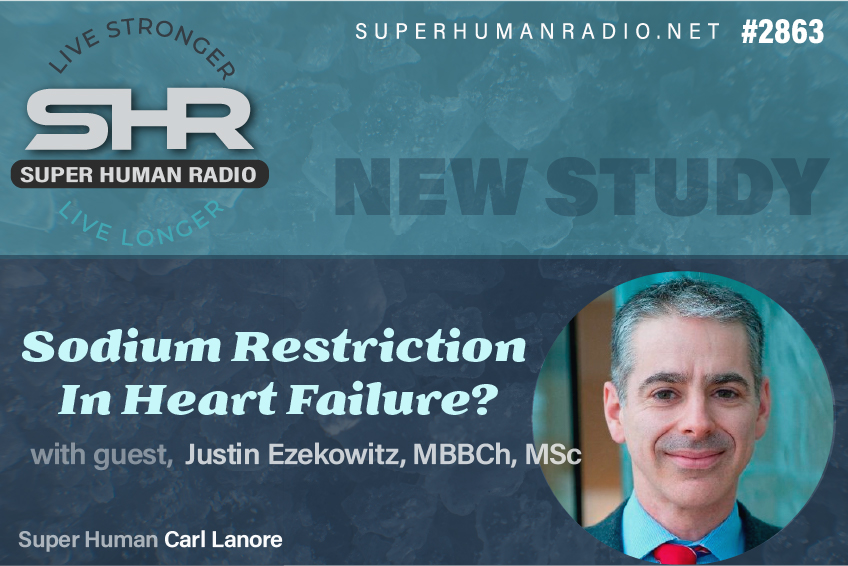
Sodium Restriction In Heart Failure?
with guest Justin A. Ezekowitz, MBBCh, MSc
For years physicians have ordered their patients to restrict sodium for a variety of reasons. High blood pressure, cardiac function and heart failure are a few. The theory is that sodium attracts water and that fluid retention increases the blood volume thus increasing pressure in the heart and blood vessels. A recent study may show why this isn't working.
Play
Show Notes:
Sodium Restriction in Heart Failure?
[00:05:03] Sodium is an important electrolyte and sodium homeostasis is critical.
[00:06:29] Literature from the late 1800s up to the 1970s suggest lowering intake of dietary sodium for various illnesses, including hypertension and heart disease.
[00:06:59] Kidneys help regulate all the electrolytes in our body. Could we be pushing people into kidney problems by restricting their sodium?
- The kidneys and heart are intimately linked.
- There is a difference between prevention of a disease versus active management of the disease.
- There is a recognition that sodium intake strategies differ when we are talking about prevention vs management.
[00:10:16] The design of the study:
- Designed a large clinical trial which included recruiting people with established heart failure (heart not functioning well) for 1 or more years.
- Over 800 people participate in the randomized trial.
- Participants were allocated to usual care including reducing dietary sodium intake vs a group that took a strict less than 1500mg of sodium per day.
- Wanted to see if that changed the rate of clinical events and also measure the quality of life and functionality.
- The main focus was on the first year followed by follow-ups.
- Dieticians from six countries created set menus, changing the sodium content only.
- The menus were country and culture specific.
- Participants were required to keep real-time 3-day food diaries.
- Results took 20% under and over reporting into consideration.
[00:17:27] Expectations were for a 500 m of sodium per day reduction. To get people below 1500 mg per day was the actual target.
[00:18:44] Carl explains “salt” in everyday terms – worth the listen!
[00:19:39] Findings:
- Main outcome of the trial was to reduce the risk of all-cause death, or cardiovascular hospitalizations and cardiovascular ER visits.
- Statistically it did not reduce those the way we formally assessed, and we make sure that it is well understood.
- But numerically there were fewer events in the lower sodium arm than in the usual care arm.
- There was thus some effect, just not the effect that was anticipated.
[00:21:36] Other interesting outcomes - tune in!!
[00:23:27] Why are we looking at just sodium when magnesium could be the reason some people do well, and some people do not?
- The process is very much driven by the fuel that people are eating, and the different switches made inside the heart muscle cells and the mitochondria.
- It is driven by a lot of different processes and various micronutrients, of which magnesium is just 1.
[00:33:30] 3 Clear messages from the trial.
- Clinicians need to consider sodium reduction for patients with heart failure to improve quality of life.
- For patients, it should be part of their overall health strategy to consider a healthier diet overall
- Guidelines for those who make policies.
[00:34:15] A remarkably interesting discussion on differentiating athlete hearts (and those of active individuals) from the general public, ensues.
[00:40:22] The best advice you can give to a patient is to avoid things in a box, a bag, or a can and refined processed foods.
[00:41:47] Carl shares a few fascinating facts about the military.
[00:42:32] The idea that consuming more sodium to lessen blood viscosity, is flawed. Dr Justin explains.
[00:45:38] A detailed discussion on blood pressure, hormones and hypertension follows.
[00:53:17] In conclusion, Dr Justin reiterates that it is really important for people to know that they can do a lot of simple uncomplicated things to promote health and self-care.
Stay in touch with us! Get show highlights, tips, new research & offers in your inbox.
Latest Episodes

SHR #3033: The Truth about Glyphosate and Disease
May 02, 2026

SHR #3032: Coming off of GLP one agonist and not putting on a bunch of fat
Apr 14, 2026
SHR #3025: Should You Fear the Fairway?
Feb 21, 2026

SHR #3031: The Sepsis Show
Feb 16, 2026

SHR #3030: Cheating Death
Feb 11, 2026
SHR #3029: The Ultimate Anabolic Steroid Research Guide
Oct 31, 2025

SHR #3028: Slow Aging. Prevent Disease.
Oct 23, 2025


SHR #3026: The Magic of Proper Stress Management
Dec 24, 2023
SHR #3023: The Prime Act - Getting the USDA Out From Your Farmers Way
Sep 19, 2023

SHR #3022: NAD, NMN and NR; Is There Something Safer?
Sep 18, 2023

SHR #3021: The Legend Of Christian Boeving
Sep 17, 2023

SHR #3020: The Sleep Talk
Sep 14, 2023