
• +1 502-690-2200
  • This email address is being protected from spambots. You need JavaScript enabled to view it.

Modest consumption of sugar does not negatively affect blood glucose homeostasis unless it is pure isolated fructose

Modest consumption of sugar does not negatively affect blood glucose homeostasis unless it is pure isolated fructose


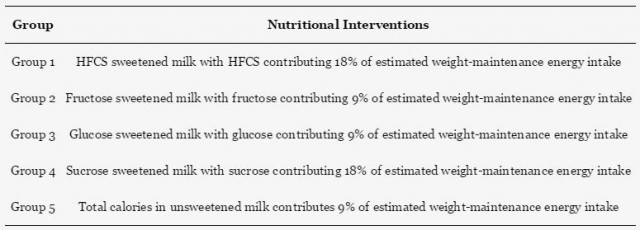
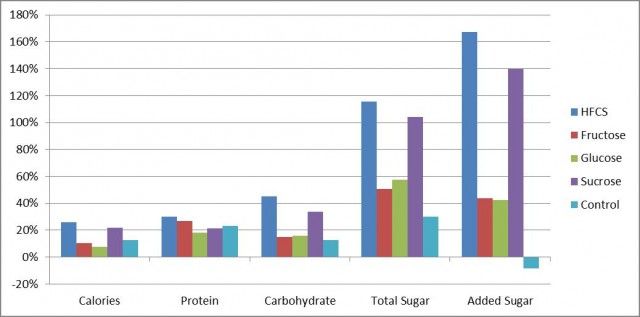
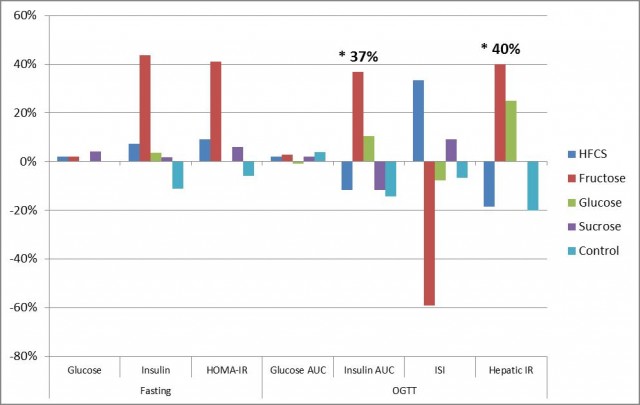
The role of fructose in health and disease is a controversial one. I have previously written about a systematic review and meta-analysis of 59 experimental trials and over 1,000 participants that showed fructose-containing sugars acted no differently from other carbohydrates with regard to their effects on blood lipids. However, blood lipids are only one aspect of health. Glucose metabolism, or the body’s ability to handle changes in blood glucose levels, is another important player in chronic disease, most notably type-2 diabetes. If a significant link between fructose and insulin resistance exists, then this is reason enough to change dietary habits and recommendations. As such, researchers from the Rippe Lifestyle Institute decided to conduct a 10-week randomized, parallel-group, partially-blinded study to assess the effects of incorporation of various sugars into the diet of 158 otherwise healthy individuals. The diet This study was designed to assess the impact of incorporating modest amounts of...
Continue reading
  1687 Hits

Super Human Roundup: Should patients with fatty liver go paleo? How can we help them get there?

Super Human Roundup: Should patients with fatty liver go paleo? How can we help them get there?


Should Patients with Metabolic Syndrome-related NAFLD be on the Hunter-Gatherer (Paleo) Diet to Decrease Morbidity? The paleo diet is no longer a fad among the alternative health community. It really was only a matter of time before Tarantino et al from Italy asked a central question – can a paleo diet reduce non-alcoholic fatty liver disease (NAFLD) prevalence? Their review begins with a basic recap of the differences between what they call a hunter-gatherer (HG) diet and modern Western diets. This includes the HG diet being anti-atherogenic and high in unsaturated fat, containing a variable amount of carbohydrates from fibrous and starchy vegetables rather than cereal grains, and being relatively high in protein. Additionally, the potassium-sodium ratio and fiber intake is much higher and the overall diet composition is more alkaline.   There is indeed evidence to support the beneficial effects of a HG diet on health. Tarantino et al mention...

Continue reading
  2032 Hits

A true high-protein diet (3.4 g/kg) results in better body composition than a normal diet (2.3 g/kg) in healthy weight training men and women.

A true high-protein diet (3.4 g/kg) results in better body composition than a normal diet (2.3 g/kg) in healthy weight training men and women.


If you are a lean, healthy, resistance-training individual interested in building muscle and maximizing body composition, then you are part of a unique and understudied population when it comes to the ideal amount of protein you should be eating. Owed in no small part to the current health state of the world, most research investigating the effects dietary protein on body composition and health is done in unhealthy individuals. From what limited evidence does exist, it has been suggested that protein intakes beyond 2.2 g/kg bodyweight have no additional advantages with regard to body composition or performance. Yet, there is a distinct lack of research looking at intakes beyond this amount. This is what makes research such as the recent study by Antonio et al so exciting – it does investigate the effects of a high-protein diet in a resistance-trained population. The Diet In total, 48 otherwise healthy, resistance-trained men and...

Continue reading
  7455 Hits

More Bad News For Women: Glyphosate Contamination Found In Tampons

More Bad News For Women: Glyphosate Contamination Found In Tampons

A team of Argentine researchers have discovered glyphosate (Roundup by Monsanto) present in 85% of cotton containing personal care and feminine hygiene products. Even if you strive to avoid glyphosate - an herbicide deemed by the World Heath Organization as a probable carcinogen - by eating exclusively organic foods you may still be exposed to it unknowingly. Researchers Dr. Damien Marino of the University of La Plata wrote in their paper "85 percent of all samples tested positive for glyphosate and AMPA 62 percent, which is the environmental metabolite, but in the case of cotton and gauze the figure was one hundred percent" This is horrible news to say the least. Many of the items tested were labeled as sterilized and suitable for application on wounds which would give the glyphosate direct entry to the blood stream. In the case of tampons, the exposure would be even greater. Compounded by the...

Continue reading
  21431 Hits

What can we learn from hunter-gatherer sleep behaviors?

What can we learn from hunter-gatherer sleep behaviors?


Last week, a press release regarding the sleep duration of our ancestors was abound on numerous media outlets, all of which seemed to focus on sleep duration and use headlines that give the impression that modern sleep behaviors are not so different from pre-industrial populations. The actual study was a multi-center collaboration by researchers from the University of New Mexico, the University of California, Yale University, Hunter College, and the University of the Witwatersrand. They stayed with three different modern hunter-gatherer tribes (the Hadza, the San, and the Tsimane) and collected data on their sleep behaviors around the clock by having the tribesmen wear Actiwatch-2 devices on their wrists for 4-28 days. This collected data on movement, light exposure, and temperature that were then statistically compared to temperature, solar, and seasonal variables of the environment. The researchers did indeed find that sleep durations were similar to modern society, with the time...

Continue reading
  2147 Hits

Super Human Roundup: Less death with more movement

Super Human Roundup: Less death with more movement

Replacing sedentary time with physical activity and sleep lowers your risk of death The health benefits of moderate-to-vigorous physical activity (MVPA) and the health detriments of sedentary behavior (SB) are well-established. It wasn’t long ago that I wrote an article on a potpourri of observational research documenting reduced risk of death with increasing MVPA and decreasing SB. Now, Stamatakis et al add to the literature base by examining the hypothetical replacement of SB with other time-dependent behaviors on death from any cause in a large cohort of 201,000 Australian adults from New South Wales. To perform their statistical analysis, the researchers used isotemporal substitution modeling, which estimates the effects of replacing one behavior with another while controlling for confounding by other time-dependent behaviors. In other words, this model can tell us how a 60-minute block of low-intensity walking will have different health effects depending on whether it displaces an equal amount of...

Continue reading
  1312 Hits

Can a 40% caloric deficit reverse early-onset diabetes? Yes, yes it can.

Can a 40% caloric deficit reverse early-onset diabetes? Yes, yes it can.


When blood sugar levels rise, the pancreas releases insulin. In healthy people this is sufficient to reduce blood sugar because the insulin tells the rest of the body to take up the glucose from the blood. In people with obesity, their bodies are less sensitive to insulin’s signal – called insulin resistance. The pancreas can compensate for this temporarily by producing more insulin, but at some point the pancreas will not be able to keep up, and then blood sugar levels start to rise. This is type-2 diabetes. The incredibly over-simplified explanation above sets the stage for a recent publication by Gao et al from the Beijing Anzhen Hospital, China, who used diet-induced obese (DIO) mice to explore if caloric restriction is capable of reversing pancreatic β-cell dysfunction. As illustrated in figure 1, 4-week old male C57BL/6 mice were fed a high-fat diet (HF) or normal chow (NC) for 8 weeks,...

Continue reading
  3623 Hits

Does vitamin D affect muscle growth and strength?

Does vitamin D affect muscle growth and strength?


In a previous article regarding a study performed with mice, we learned that vitamin D is per se necessary for muscle growth and development. The research showed that vitamin D deficiency brought about as a result of genetic deletion of the vitamin D receptor (VDR) led to significant reductions in muscle mass and strength and significant increases in the expression of myostatin and related catabolic genes. Similar but less pronounced changes were observed in healthy mice fed a vitamin D deficient diet as well, suggesting that it is vitamin D signaling that modulates the responses. Now if I were to ask what the number one way to build muscle is, I bet the response would be a majority “resistance training.” This raises the question: Does vitamin-D intake during resistance training improve the skeletal muscle hypertrophic and strength response? Fortunately, an answer comes from a recent publication by Agergaard et al, who...

Continue reading
  4381 Hits

Super Human Roundup: Beyond food and towards cooking, insects vs meat, and coffee for metabolic syndrome

Super Human Roundup: Beyond food and towards cooking, insects vs meat, and coffee for metabolic syndrome


Must we look beyond the food itself and towards how it’s prepared? The Mediterranean diet (MD) has no shortage of observational and experimental evidence supporting its healthfulness. Much of this comes down to the anti-inflammatory and antioxidant nature of the diet. However, food preparation and cooking influence the nutritional qualities of foods and customs in non-Mediterranean countries may be quite different from those in Mediterranean countries. Yet, this is rarely considered when applying findings on the MD derived from one population to a different population with a different cuisine. But does it matter? That is the central question of the recent review by Hoffman and Gerber, who examined how antioxidant and anti-inflammatory phytochemicals in some of the main food groups of the MD (olives and olive oil, vegetables and nuts) are influenced by food preparation and cooking. The MD is most well-known for its use of olive oil, and most clinical...

Continue reading
  1298 Hits

Metabolic adaptation to caloric restriction and subsequent refeeding

Metabolic adaptation to caloric restriction and subsequent refeeding


Caloric restriction and weight loss are associated with decreases in resting energy expenditure (REE). This makes sense when we understand that less body mass means there is less tissue that needs to be kept alive. However, there is often a decrease in REE beyond those decreases accounted for by changed fat-free mass (FFM) and fat mass (FM), which has become known as adaptive thermogenesis (AT). This is essentially the body’s way of fighting against weight loss in response to perceived starvation. AT was first described in the Minnesota Starvation Experiment, where men ate half of their daily energy requirements for six months and ultimately lost 24% of their initial bodyweight. Their REE was reduced by 40%, of which only two-thirds could be attributed to weight loss. However, the Minnesota Starvation Experiment was conducted in the 1940s and 50s, leaving open room for error through the use of now outdated technology. Additionally,...

Continue reading
  2416 Hits
SHR Logo

Super Human Radio is the world's longest running broadcast dedicated to health, fitness & anti-aging with an emphasis on exercise, nutrition, and hormone management. This one of the most progressive podcasts for preventative & regenerative techniques designed to increase longevity. More

2908 Brownsboro Rd Ste 103
Louisville, Kentucky 40206

(502)-690-2200

SHR Logo

Super Human Radio is the world's longest running broadcast dedicated to fitness, health, and anti-aging with emphasis on exercise, nutrition, and hormone management. The most progressive source of information for preventative & regenerative techniques... More

2908 Brownsboro Rd Ste 103
Louisville, Kentucky 40206
United States of America

+1 502-690-2200