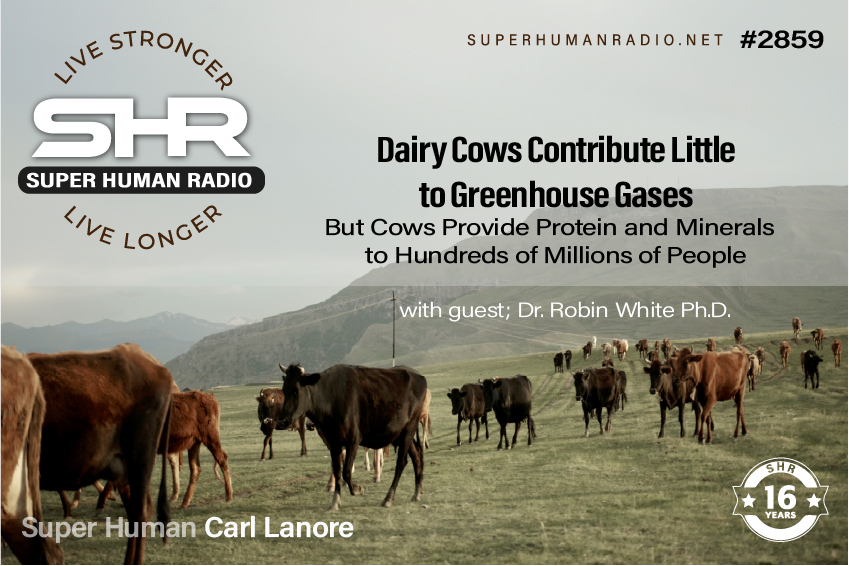
Dairy Cows Contribute Little to Greenhouse Gases But Provide Protein and Minerals to Millions
with guest Dr. Robin White Ph.D.
Research in the Journal of Dairy Science® examines the potential impact of various animal removal assumptions on the environment and nutritional supplies. The US dairy industry contributes roughly 1.58% of the total US greenhouse gas emissions; however, it also supplies the protein requirements of 169 million people, calcium requirements of 254 million people, and energy requirements of 71.2 million people. A suggested solution to increasing food production worldwide while reducing greenhouse gas emissions has been to eliminate or reduce animal production in favor of plant production. In an article appearing in the Journal of Dairy Science, scientists from Virginia Tech and the US Dairy Forage Research Center studied the effects of dairy product removal on greenhouse gas emissions and nutrient availability in US diets under various removal scenarios.
Play
Show Notes:
Dairy Cows Contribute Little to Greenhouse Gases but Provide Protein and Minerals to Millions
[00:02:54] Dr. Robin explains what led her to the study.
[00:05:00] The projected net results (a study from 2017) of what would happen if all animal- husbandry were removed from U S agriculture:
- Greater weight of food available, but despite having more total food available, we would end up with more nutrient deficiencies.
- Additional nutrients that would not be produced in sufficient quantity to meet the needs of the U S population.
- The greenhouse gas benefit associated with this dramatic shift in the agricultural system would result in less than a 3% reduction in total US greenhouse gas emissions.
[00:08:02] Why was only dairy cows studied in this particular study?
- A substantial portion of that contribution in terms of human edible nutrients is coming from our dairy industry.
- Associated with higher contributions to greenhouse gas emissions.
- They became an interesting case study to evaluate some of the assumptions that was made in the 2017 paper.
- This dairy cattle study allowed us to address some of the additional questions.
[00:10:23] A discussion ensues on the greenhouse gas emissions between pastured cows and grain fed cows.
[00:12:44] Dr Robin elaborates on 3 separate ways to assess the potential impact reducing or eliminating dairy cows in general.
- Retirement scenario – impact would be negligible.
- Economically realistic scenario i.e., export all – no impact.
- Depopulation scenario – impact would be negligible.
[00:18:30] The vast majority of cattle grazing in the U S is done on land that is not suitable for other purposes. Discussion on land repurposing and grazing management follows.
[00:23:30] Dr Robin explains that there are various sources of emissions that are quantitatively more important than agriculture. She further elaborates the misunderstanding in the application of global data to local scenarios.
[00:31:29] From a nutrient standpoint, what do we lose? And is it more important than what we gain in the elimination of 0.7% greenhouse gases?
- Dairy cattle contribute a tremendous amount of the protein and amino acids available for human consumption from the agricultural system in the US.
- Providing an important source of some essential fatty acids, vitamins, and minerals.
- We do however see increases in the availability of amino acids from the agricultural system if we shift away from dairy cattle production.
- The bioavailability and concentration of that is really in question.
- This would force us to eat higher volumes thereby dramatically exceeding our energy requirements.
[00:35:39] The role of milk in general.
- Milk is the only thing made by nature to be sustaining for a given species.
- Bovine milk and human milk are remarkably close.
- Raw bovine milk has transporter and chaperone proteins which take things that are good for us and carry them into the bloodstream.
[00:37:49] When we look at the elimination of dairy cows completely for the impact on greenhouse gases, and then we look downstream at the literal elimination of nutrients from the available diet, which one wins?
[00:37:29] Dr. Robin White Ph.D.: Is not that a good question. Um, this is one of those really important associated economic challenges we need to agree upon how we are going to address as a society.
- The major goal of the agricultural system is to provide sufficient sustenance for humans.
- There is international exchange of nutrients through agricultural imports and exports.
- Food should be provided in a manner that does not impede our ability to continue that work for future generations.
- By enhancing the efficiency of our production system, we produce more food with fewer animals or less land thereby dramatically reducing the environmental footprint.
- We are however not out of the woods yet.
[00:46:44] A discussion follows on how, if at all, there is a difference between the impact of beef versus dairy cattle on the environment.
[00:49:49] Food labelling in the USA is not always well-suited to helping the average consumer figure out what is a reliable source of nutrients. The minimum requirements on the types of nutrients that must be reported on food labels mean that we assume that those are the only nutrients provided by the food.
[00:51:50] Carl speaks a bit on soy production being unsustainable.
[00:54:20] Dr. Robin explains her take on what water footprint means and the misconception around what a carbon or a water footprint means when evaluated.
[00:55:30] It is time for people to understand the realities of what they are being told. Beef is not destroying the planet
Stay in touch with us! Get show highlights, tips, new research & offers in your inbox.
Latest Episodes
SHR #3033: The Truth about Glyphosate and Disease
May 02, 2026

SHR #3032: Coming off of GLP one agonist and not putting on a bunch of fat
Apr 14, 2026
SHR #3025: Should You Fear the Fairway?
Feb 21, 2026
SHR #3031: The Sepsis Show
Feb 16, 2026
SHR #3030: Cheating Death
Feb 11, 2026
SHR #3029: The Ultimate Anabolic Steroid Research Guide
Oct 31, 2025
SHR #3028: Slow Aging. Prevent Disease.
Oct 23, 2025

SHR #3026: The Magic of Proper Stress Management
Dec 24, 2023
SHR #3023: The Prime Act - Getting the USDA Out From Your Farmers Way
Sep 19, 2023
SHR #3022: NAD, NMN and NR; Is There Something Safer?
Sep 18, 2023

SHR #3021: The Legend Of Christian Boeving
Sep 17, 2023
SHR #3020: The Sleep Talk
Sep 14, 2023