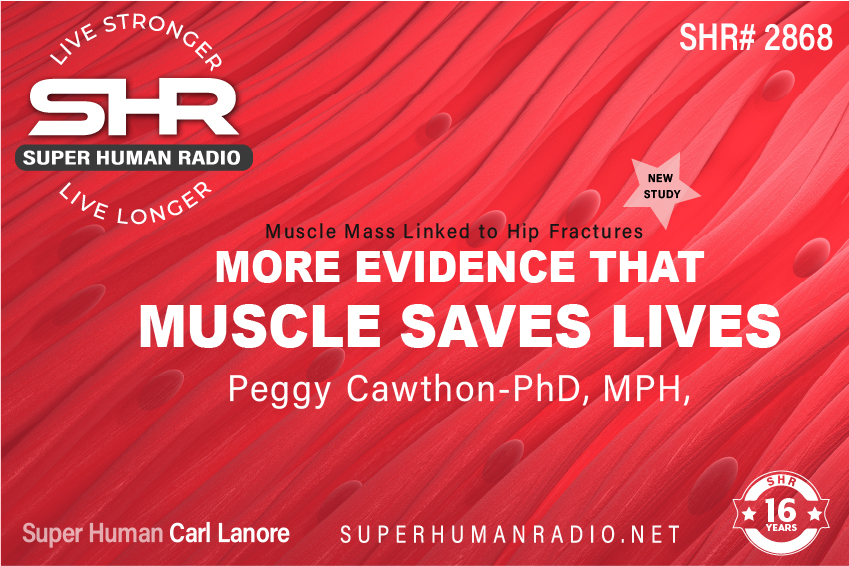
More Evidence That Muscle Saves Lives
with guest Dr. Peggy Cawthon, PhD, MPH
NOTE: Due to technical issues this is a commercial freer show. Enjoy. I did my first show connecting strength and muscle to longevity back in 2006 and have continued to do shows that prove that. Today we discuss a new study that links muscle mass to injuries associated with aging. Older men with lower amounts of muscle mass have significantly increased risk of hip and potentially other fractures, new research led by investigators at Sutter Health’s San Francisco Coordinating Center (SFCC) in San Francisco, CA has shown.
Play
Show Notes:
More Evidence That Muscle Saves Lives
[00:03:00] Motivating factors contributing to doing this study.
- The associations between muscle and aging and the way we often measure it in studies, is not as strong as you would expect.
- Muscle quality is important, but it seems that the absolute amount of muscle mass a person has, is indispensable.
- DEXA scans have limitations.
- Another tool was needed to accurately measure muscle mass.
- The D3-Cr (Deuterated Creatine Dilution) protocol to assess muscle mass, was intriguing.
[00:05:21] D3Cr uses a labeled Creatine, explain what that does?
- We leverage some facts about creatine biology to make this work.
- Almost all the creatine in your body is found in the muscles.
- Figuring out how much creatine is in your body will enable you to figure out how much muscle you have.
- Creatine is found in the muscle at a relatively constant concentration.
- Creatine is converted to creatinine which is rapidly excreted in the urine.
[00:09:32] This measurement focusses on measuring the energetic potential of muscles as opposed to the total amount of muscle.
[00:11:37] The design of the study:
- This study was 1 of many in a Project.
- 1 Of the studies was called, The osteoporotic fractures in men study.
- Was initially designed to look at risk factors for fracture in older men.
- The study expanded its focus from just osteoporosis to other conditions of aging.
- The muscle mass measure was added to one of the follow-up visits.
- The D3Cr is strangely predictive of mortality.
- People with below 25% of the muscle measures, we are 3 times more likely to die than people in the highest quartile.
- People in that lowest 25% were about 6 times more likely to have a hip fracture than people in the upper quartile.
[00:14:14] Bone mineral density is affected tremendously by how strong you are. The stronger you get, the greater, the demand for mineralization of your bones becomes.
[00:16:56] Carl talks about the California VA Study.
[00:17:36] Dr Peggy elaborates on the mortality factor in her study.
[00:19:43] The number one risk factor for Dementia and Alzheimer's is metabolic derangement.
[00:21:03] For scientists understanding the way exercise works will help uncover pathways that we could have other therapies to improve mobility for very frail or injured people.
[00:21:40] Carl eloquently discusses about anabolic steroids and SARMs (selective androgen receptor modulators), you have to listen!
[00:25:56] Were there any things that jumped out at you in this research?
- It was surprising to me is how close to what we expected the results were when they were even a little bit stronger than I expected.
- The association with hip fracture results was a major surprise
- The fact that the measure of muscle mass is a strong predictive of mortality was also surprising.
[00:27:58] What do you hope people take away from your research?
- That it reinforces that muscle saves lives.
- That muscle's importance is often overlooked.
- To get clinicians in particular to think about muscle and how to implement assessing muscle either through this measure or through a standardized measure for muscle function.
- To produce a standard way to measure and integrate it into clinical care.
[00:29:00] Carl suggests the bodybuilding way of measuring muscle mass, Dr Peggy replies.
[00:31:56] Is muscle mass independently important of the strength that the muscle produces?
- The data shows that it is both mass and how strong you are that are associated with things like disability, immobility, and hip fractures.
[00:33:00] An interesting discussion ensues on the possibility of a formula that intersects muscle mass and its ability to function.
[00:36:38] Carl shares his theory on metabolic debris accumulation, tissue innervation and blood flow – tune in!
[00:37:14] Dr Peggy replies on Carl’s theory that there is a new study where muscle biopsies were done on about 900 older people. Results will be out soon.
[00:41:12] Limitations and next steps for the project.
- The big limitation of our study is that this measure was added to an ongoing study of older men that were mostly white.
- We therefore do not have a lot of data about particularly important subsets of the population like women or minority populations or people outside the U S.
- We have been doing a lot of work to add this measure to certain studies that have this measure in women or to under-representative populations.
- The associations are mostly the same in women, but there may be a few significant differences.
- We would like to understand all the differences.
[00:42:03] As a rule, women live longer, but with more disability. The aim is to figure out what role muscle plays in this fact.
[00:43:04] The noble pursuit of muscle – stronger is younger!
Stay in touch with us! Get show highlights, tips, new research & offers in your inbox.
Latest Episodes

SHR #3033: The Truth about Glyphosate and Disease
May 02, 2026
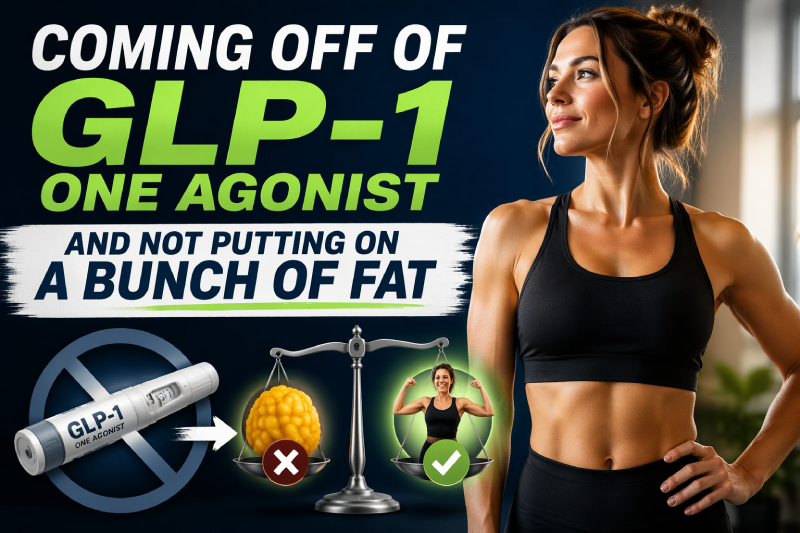
SHR #3032: Coming off of GLP one agonist and not putting on a bunch of fat
Apr 14, 2026
SHR #3025: Should You Fear the Fairway?
Feb 21, 2026

SHR #3031: The Sepsis Show
Feb 16, 2026
SHR #3030: Cheating Death
Feb 11, 2026
SHR #3029: The Ultimate Anabolic Steroid Research Guide
Oct 31, 2025

SHR #3028: Slow Aging. Prevent Disease.
Oct 23, 2025

SHR #3026: The Magic of Proper Stress Management
Dec 24, 2023

SHR #3023: The Prime Act - Getting the USDA Out From Your Farmers Way
Sep 19, 2023
SHR #3022: NAD, NMN and NR; Is There Something Safer?
Sep 18, 2023

SHR #3021: The Legend Of Christian Boeving
Sep 17, 2023
SHR #3020: The Sleep Talk
Sep 14, 2023