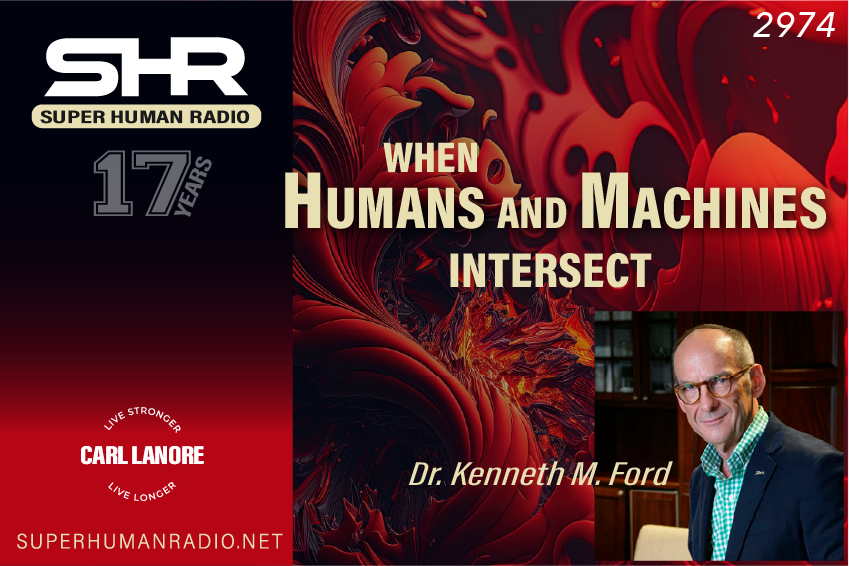
When Humans and Machines Intersect
with Guest Dr. Kenneth M. Ford
The Institute For Human & Machine Cognition is working on many project that will impact future humans in profound ways. Robots, exoskeletons, cognitive and spatial orthotics will not only allow people to function at higher levels but also impact the aging human condition and longevity as we know it. Listen and learn.
CARL RECOMMENDS: superhumanradio.net/carl-recommends
View and download all shows at https://superhumanradio.net
Visit us on Instagram: @superhumanradio
Support SHR - https://superhumanradio.net/make-a-donation
THANK YOU
Play
Show Notes:
When Humans and Machines Intersect
[00:01:00] Carl welcomes Dr Ford, the founder, and CEO of the Institute for Human and Machine Cognition (IHMC) after which Dr Ford explains why he was attending the Ancestral Health Symposium.
[00:01:56] Dr Ford describes the mission of the Institute for Human and Machine Cognition and expounds on some of the areas and projects they excel in.
[00:05:39] Carl shares his view on being able to do things at a standard that you become accustomed to, that aging sometimes steals from you. Dr Ford joins in.
[00:07:49] This could be a great advantage to individuals suffering from neurologically degenerative diseases like Parkinson's Disease and Alzheimer’s. How do you interface with the brain? Dr Ford responds.
[00:13:46] The discussion turns to futuristic possibilities of using computers with our brains instead of using our hands.
[00:15:20] Dr Ford explains how his group is working on the ability of machines to enhance cognitive function and even perception.
[00:17:34] He goes on to illustrate a practical application for cognitive enhancement.
[00:20:18] Carl asks Dr Ford to elucidate more on how, why, and where cognitive and physical orthotics would apply.
[00:22:25] Carl talks about the possibility of how this concept could be applied to sport as stealth robotic enhancement and asks Dr Ford about DARPA (Defense Advanced Research Projects Agency).
[00:28:35] The discussion continues on how NASA could make use of these robotics and exoskeletons.
[00:30:00] Dr Ford explains how what they do is different from e.g., the company Lockheed Martin which is also working on these exoskeletons.
[00:31:21] Tune in for the remarkable discussion on the formidable 330-pound humanoid, called Atlas – do not miss it!
[00:35:18] The next topic of discussion is standardization and information sharing pertaining to these robots.
[00:37:00] Dr Ford eloquently responds to Carl’s follow-up question on battery power and energy consumption, which could potentially limit everybody's ability to do what they want to do.
[00:39:20] He goes on to explain how much of the existing infrastructure will contribute to making this robotic project more of a possibility.
[00:32:50] An interesting conversation follows on the theory that the fact that people are working on these projects, could be due to us believing it could happen, or is it that we believed it could happen because intuitively we knew that this was out there?
[00:43:40] Some discussion follows about the YouTube channel for IHMC and the various subjects they are involved with.
[00:37:54] Dr Ford describes what the future holds in store for IHMC.
[00:47:00] Does it require a scientist to straddle two worlds when they're in your type of environment? Dr Ford responds, and the discussion evolves.
Stay in touch with us! Get show highlights, tips, new research & offers in your inbox.
Latest Episodes

SHR #3033: The Truth about Glyphosate and Disease
May 02, 2026

SHR #3032: Coming off of GLP one agonist and not putting on a bunch of fat
Apr 14, 2026
SHR #3025: Should You Fear the Fairway?
Feb 21, 2026
SHR #3031: The Sepsis Show
Feb 16, 2026
SHR #3030: Cheating Death
Feb 11, 2026
SHR #3029: The Ultimate Anabolic Steroid Research Guide
Oct 31, 2025
SHR #3028: Slow Aging. Prevent Disease.
Oct 23, 2025

SHR #3026: The Magic of Proper Stress Management
Dec 24, 2023
SHR #3023: The Prime Act - Getting the USDA Out From Your Farmers Way
Sep 19, 2023
SHR #3022: NAD, NMN and NR; Is There Something Safer?
Sep 18, 2023

SHR #3021: The Legend Of Christian Boeving
Sep 17, 2023
SHR #3020: The Sleep Talk
Sep 14, 2023
Latest Episodes
SHR #3033: The Truth about Glyphosate and Disease
May 02, 2026
SHR #3032: Coming off of GLP one agonist and not putting on a bunch of fat
Apr 14, 2026
SHR #3025: Should You Fear the Fairway?
Feb 21, 2026
SHR #3031: The Sepsis Show
Feb 16, 2026
SHR #3030: Cheating Death
Feb 11, 2026
SHR #3029: The Ultimate Anabolic Steroid Research Guide
Oct 31, 2025
SHR #3028: Slow Aging. Prevent Disease.
Oct 23, 2025
SHR #3026: The Magic of Proper Stress Management
Dec 24, 2023
SHR #3023: The Prime Act - Getting the USDA Out From Your Farmers Way
Sep 19, 2023
SHR #3022: NAD, NMN and NR; Is There Something Safer?
Sep 18, 2023
SHR #3021: The Legend Of Christian Boeving
Sep 17, 2023
SHR #3020: The Sleep Talk
Sep 14, 2023

