
• +1 502-690-2200
  • This email address is being protected from spambots. You need JavaScript enabled to view it.

Creatine is good for the bones of postmenopausal women

Creatine is good for the bones of postmenopausal women
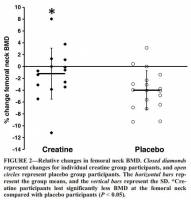
Relative changes in femoral neck BMD.

If I were to recommend a single supplement for another to take, it would be creatine monohydrate. Its benefits spread far beyond increases in muscle mass and athletic performance towards neurological protection and musculoskeletal health. More recently, creatine has been suggested as a maternal supplement to act as a “multi-organ protectant” for the fetus and neonate that gives it a promise not provided by the current therapies. Most importantly, creatine has an overwhelming base of evidence demonstrating it to be safe. Now, a new study extends creatine’s benefits onto the bone health of postmenopausal women. In this double-blind, parallel-group, randomized controlled trial, 33 otherwise healthy postmenopausal women engaged in a 12-month supervised resistance training program with or without creatine supplementation of 0.1 g/kg/day consumed in a split dose before and after training sessions or with two separate meals on non-training days. Exercise training involved fully supervised resistance training three times per week. Exercises...

Continue reading
  1940 Hits

Super Human Roundup: Olive oil and fiber for diabetes and the motivating factors and barriers to healthy eating in young men

Olive oil protective against type-2 diabetes in women That’s the conclusion of a recent paper by researchers from the Harvard School of Public Health who analyzed data of over 145,000 women from the Nurses’ Health Study I and II. After a 22-year follow-up, it was found that each additional 8 gram intake of olive oil was associated with a 6% reduced risk of developing type-2 diabetes, regardless of whether it was consumed as a salad dressing or added to food or bread. Additionally, replacing 8 grams of stick margarine, butter, or mayonnaise with 8 grams of olive oil was associated with a 5, 8, & 15 % predicted lower risk of T2D, respectively. Is soluble fiber protective against type-1 diabetes? A low-fiber diet has been associated with other inflammatory or autoimmune diseases such as colon cancer and irritable bowel syndrome, so why not type-1 diabetes as well? Soluble fibers may be...

Continue reading
  1557 Hits

Diet and weight loss are more important than exercise in the overweight-obese

Diet and weight loss are more important than exercise in the overweight-obese
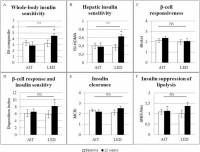
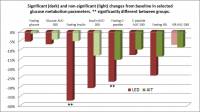
Changes from baseline in parameters of glucose metabolism
insulin sensitivity

There are many benefits to be gained from exercise and weight loss in the overweight-obese population, and both are commonly prescribed to achieve cardiometabolic health improvements. However, exercise for weight loss is an inefficient and unsustainable route for many individuals. Instead, exercise should be done for health while weight loss is achieved through dietary modifications. But which has a greater impact? The answer comes from the University of Copenhagen, Denmark who recently published additional data from the CUT-IT study where 64 overweight-obese out-patients (age 45-75 years) with coronary artery disease (CAD) were randomized to undergo 12 weeks of aerobic interval training (AIT) three times weekly or consume a low-energy diet (LED) for 8-10 weeks followed by 2-4 weeks of transition to a high-protein/low-glycemic index diet. The AIT protocol involved a 38 minute session beginning with a 10-minute moderate-intensity warm-up followed by high intensity interval training (85-90% of VO2peak, Borg scale 17–18) on...

Continue reading
  4641 Hits

Weekly beats daily for fish oil bioavailability

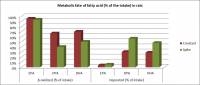
Metabolic fate of EPA, DPA, and DHA in rats.

There is a vast body of literature evaluating the health effects of fish oil and the quantity needed to benefit. Although therapeutic approaches can be taken, such as using high-doses of fish oil to battle fatty liver and reduce triglycerides, fish oil’s benefits generally come from balancing our body’s n-3/6 ratio. In this regard, many authoritative bodies have put out recommendations for EPA and DHA intake, either as a weekly or daily goal. To date, only two studies (here & here) have compared daily vs twice weekly supplementation of fish oil and found no difference when blood levels were used as a proxy for bioavailability. However, when referring to nutrients, bioavailability is used to describe how much of an orally administered nutrient is actually retained in the body after being digested and absorbed. According to Schuchardt and Hahn, LC n-3 FA can be detected in the blood in various forms. These include...

Continue reading
  2667 Hits

If you’re losing weight, fructose doesn’t matter

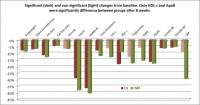
Changes in weight and blood-borne variables after eight weeks.

Over the last decade, there has been a considerable amount of literature dedicated to clarifying the role that fructose plays in health and disease. Unlike glucose, fructose is primarily metabolized within the liver and bypasses a critical rate-limiting step (phosphofructokinase) in the energy production pathway of glucose. Bypassing this step means that the metabolism of fructose is less controlled than the metabolism of glucose, and this is the main reason why fructose and glucose have different metabolic effects. It has been shown in healthy adults that fructose stimulates DNL (de novo lipogenesis; the creation of fatty acids) to a greater extent than glucose, and this is the main reason why fructose has been portrayed as particularly harmful. However, isotopic tracer studies in humans suggest that 50% of ingested fructose is converted into glucose, 25% into lactate, at least 15% into liver glycogen, and only 10% oxidized directly or converted to fatty...

Continue reading
  2053 Hits

Super Human Roundup: Vegetarianism more common in eating disorders, FDA’s cheese regulation inconsistent, and intermittent fasting not well researched

Super Human Roundup: Vegetarianism more common in eating disorders, FDA’s cheese regulation inconsistent, and intermittent fasting not well researched

Vegetarian? You might have an eating disorder. At least, that’s the takeaway from the latest work of Kelly Zuromski et al. published in Eating Behaviors that examined the prevalence of vegetarianism within three female samples with varying severity of eating disorder symptoms (i.e., nonclinical, subclinical, clinical). All participants came from locations in the southeastern U.S., and were included in the nonclinical group if they denied any lifetime eating pathology and were included in the subclinical group if they endorsed any eating pathology (i.e., fasting, binge eating, self-induced vomiting, laxative use, and excessive exercise) in the past month. The clinical group was women recruited from an eating disorder treatment center. Generally, the nonclinical group ate a wider variety of foods compared to the other groups. The prevalence of self-identified, lifetime vegetarianism was lowest in the nonclinical group (6.80%), and highest in the clinical group (34.80%), with the subclinical group falling in between (17.60%). Additionally,...

Continue reading
  1806 Hits

Are the “healthy” obese more physically active?

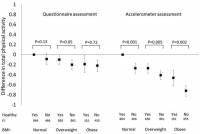
Differences in total physical activity across metabolic and obesity phenotypes based on questionnaire and accelerometer assessments.

Adjectives are relative, and while I would not consider any obese person to be healthy in general, there is no doubt that some obese individuals are healthier than other obese individuals. This is no different from how some normal-weight people are going to be healthier than other normal-weight people. The divide between healthy and unhealthy is typically the criterion for metabolic syndrome, which requires that an individual possess three or more of the following: abdominal obesity, hypertension, low HDL-c, high triglycerides, and prediabetes. Taking medications to manage any of these conditions also counts. Regardless of weight, common sense tells us that someone without metabolic syndrome is going to be healthier in general than someone with metabolic syndrome, and meta-analyses support this for type-2 diabetes and cardiovascular disease and mortality. A question we might ask is why some people become metabolically unhealthy? Given the vast literature base supporting the health benefits of...

Continue reading
  1581 Hits

Statins strike again! Reductions in serum DHA evident with short-term use

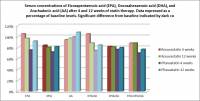
Serum changes from baseline in EPA, DHA, and AA.

Statins are quickly becoming the front-line method for primary prevention of cardiovascular disease (CVD) due to their outstanding ability to reduce LDL-cholesterol levels, and the most recent Cochrane Review indicates that statins are effective at reducing all-cause and CVD mortality. Of particular concern, however, was the fact that all trials were either fully or partially funded by pharmaceutical companies (five by Bristol Myers and Squibb, three by Pfizer, four by Astra-Zeneca, two by Merck and one by Bayer, one by Bayer and Merk, one by Pfizer, and the remaining by Sankyo Co Ltd). Moreover, the reporting of adverse events in these trials was generally poor, with failure to provide details of severity and type of adverse events or to report on health-related quality of life. There really is no doubt that statins are effective at doing what they were designed to do – lower LDL-cholesterol. However, statins don’t target LDL-c directly;...

Continue reading
  2196 Hits

Two grams of resistant starch makes rice more blood glucose friendly

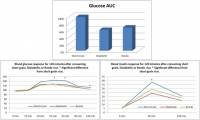
Effect of three different rice cultivars on blood glucose and insulin in healthy young adults.

There is a growing body of research suggesting resistant starches (RS) to improve glycemic control and insulin sensitivity, increase microbial diversity and digestive health, and aid in weight management. Ironically, the “unhealthy” white rice is one such source of RS, at least after it has cooked and cooled. This is because the cooking and cooling process leads to retrograded amylose and starch that is resistant to our digestive enzymes. However, the actual RS content of rice displays wide genetic diversity, with some data reporting ranges of 2 to 6.7 % dry weight. This begs the question of whether eating rice with more RS is worth the effort to seek it out, and our answer comes from the work of Alison Zenel and Maria Stewart at the University of Hawaii. They recruited 18 young and healthy men and women from their university to consume three different rice cultivars on three different occasions...

Continue reading
  2144 Hits

Super Human Roundup: Nine weeks for gains, taxing soda, and why we go to war

Nine weeks of dedicated for the elderly to see progress If you train long enough, your bound to build muscle eventually. Just how long was recently investigated by researchers from Brazil who recruited elderly men and women to undergo a 10-week resistance training (RT) program with workouts twice per week, no structured physical activity (control). Initially, the subjects warmed-up in a stationary bicycle for five minutes. Afterwards, subjects performed 4 sets x 10 repetitions with a 1-min rest interval between sets in a 45° leg press machine (G3-PL70 MATRIX, São Paulo, Brazil). In the first five weeks of training the exercise intensity was set at 70% 1-RM, based on the pre-test values; for the last five weeks, exercise intensity was increased to 80% of the re-tested 1-RM (assessed at the middle of the RT period). The range of motion at the knee joint during the leg-press was set to ~ 90°....

Continue reading
  1675 Hits
SHR Logo

Super Human Radio is the world's longest running broadcast dedicated to health, fitness & anti-aging with an emphasis on exercise, nutrition, and hormone management. This one of the most progressive podcasts for preventative & regenerative techniques designed to increase longevity. More

2908 Brownsboro Rd Ste 103
Louisville, Kentucky 40206

(502)-690-2200

SHR Logo

Super Human Radio is the world's longest running broadcast dedicated to fitness, health, and anti-aging with emphasis on exercise, nutrition, and hormone management. The most progressive source of information for preventative & regenerative techniques... More

2908 Brownsboro Rd Ste 103
Louisville, Kentucky 40206
United States of America

+1 502-690-2200