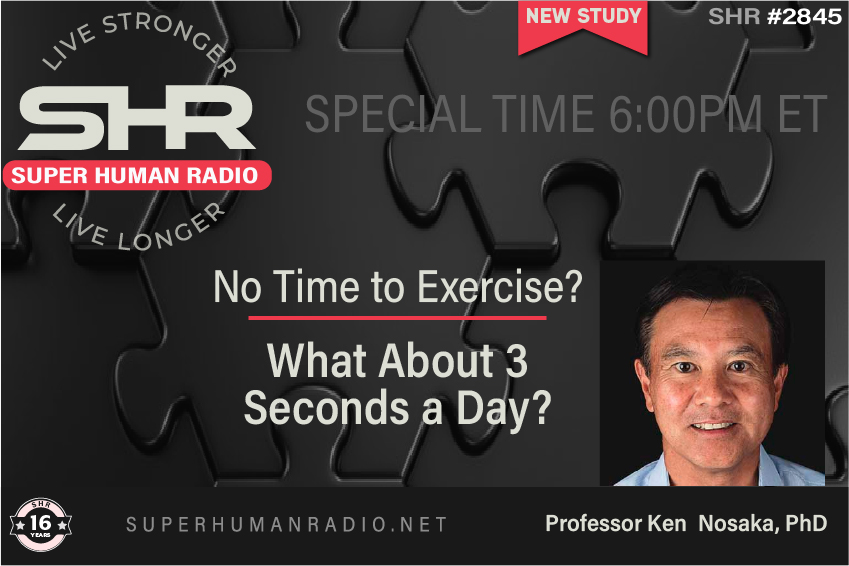
No Time to Exercise? What About 3 Seconds a Day?
with Professor Ken Nosaka, Ph.D.
A new study from the Edith Cowan University in Perth Australia provides conclusive evidence that the most effective way to build muscle and strength is through controlling the eccentric or negative portion of the weight’s movement when you use heavy weight. When compared to concentric and static holds with heavy weight, the eccentric portion of the movement elicits the greatest protein synthetic response and the greatest neuromuscular adaptations. So much so that spending as little as 3 seconds fighting the weight as you lower it is all you need to spark muscle growth. Arthur Jones first postulated this in the 1960’s and was a consideration that influenced the early development of Nautilus and it’s cam-lobe leveraging systems. Today ARX (Adaptive Resistance Equipment – http://shrnetwork.biz/arx ) exploits this phenomenon better than any other equipment company on the planet. No one wants to spend unproductive time in the gym. If that sounds like you, then a greater focus on negative or slow heavy eccentric reps is a must addition for your training program.
Play
About the Guest:
Professor Ken Kazunori Nosaka
Director of Exercise and Sports Science & PhD Coordinator of ECU
Prof Nosaka has published more than 310 peer-reviewed journal articles; his current h-index is 61 (Scopus), and about 80% of his articles are related to “eccentric exercise.” His research has been internationally recognised, and he is considered as a world leader in the area of eccentric exercise research. His other research interests include neuromuscular fatigue, strength and power training, exercise as medicine, thermoregulation, and muscle cramp. He has established collaborations with numerous institutes nationally and internationally, and is actively involved in several international collaborative research projects; more than 70% of his publications include international collaborators. He has supervised 35 PhD and 25 Masters by Research students to completion, and currently supervises 6 PhD and 2 Masters students.
Show Notes:
No Time to Exercise? What About 3 Seconds a Day?
[00:04:55] The WHO recommends that resistance exercise be done at least twice a week, but few people do it. We wanted to know how a person can still develop muscle in a short time. What if one or two contractions per day could still work? This study was based on a study published in 1953 in Germany. They did an isometric contraction for six seconds daily for a few days per week for several weeks and found significant improvement in strength. The study was to see if eccentric exercise could work better than isometric exercise to improve muscle strength.
[00:08:02] The study was designed by having participants perform exercises using a commercial level isokinetic dynamometer, focusing on bicep curls. The outcomes focus was on muscle strength and muscle growth.
[00:11:05] The initial interest was in muscle damage during the eccentric phase of 10-20 reps. This produced soreness and strength loss for up to a few days. This did not happen with only 1 contraction.
[00:12:33] Myoglobin escapes into the bloodstream when muscle tissue is damaged. Delayed onset muscle soreness is an indicator of muscle damage.
[00:13:32] Resting is especially important for muscle growth. If you are going to employ eccentric work with extreme weight, you should rest longer before you train that same muscle group again.
[00:15:00] In the study participants had 12% improvements in muscle strength by performing one eccentric contraction per day for 5 days a week, but no improvements performing 6 contractions in one day per week.
[00:19:40] The stimulus on the muscle consisted of 3 second contractions 5 days a week, in other words 15 seconds on total per week. Over the course of 4 weeks there were approximately 20% increases eccentric, isometric, and concentric muscle strength. There was no increase in muscle thickness over the 4-week period. The increases will most probably only be applicable to new trainees or sedentary individuals. It will also only be applicable to muscles that do not do usual day to day contractions.
[00:27:38] During another study there was not much difference between the eccentric and concentric contractions in the heart rate increase.
[00:30:22] Concentric contractions makes muscles fatigue earlier. Focusing on eccentric contractions will bring more mechanical stimulus to the muscles. Without a special machine, these movements can be achieved by employing the help of a spotter/training partner.
[00:33:50] Eccentric only training can increase not only strength and muscle, but also improvement in insulin sensitivity and the lipid profile.
[00:35:00] Muscle mass is invaluable in promoting insulin sensitivity.
[00:36:05] It was found that less energy is used during eccentric cycling, but after the training more energy is utilized throughout the day than with conventional cycling. Therefore, fat reduction is greater after eccentric cycling than conventional cycling.
[00:45:59] Blood flow is intact during eccentric contractions. Occluding blood flow with blood flow restriction methods during the eccentric training could be beneficial, but more studies need to be done.
[00:48:22] What was surprising from the study is the fact that atrophy can be prevented by just a few seconds of eccentric contractions per day. A sample would be during space travel where there is little means to exercise.
[00:48:48] Not only is eccentric work valuable to the athlete, to the bodybuilder, but also to the person who is not in decent shape or injured, ill or frail.
[00:50:10] Greater effects with eccentric contractions was even experienced in cross education.
[00:52:13] Many good studies show that the more muscle you carry later on in life, especially for men past 65, you have greater longevity.
Stay in touch with us! Get show highlights, tips, new research & offers in your inbox.
Latest Episodes

SHR #3033: The Truth about Glyphosate and Disease
May 02, 2026
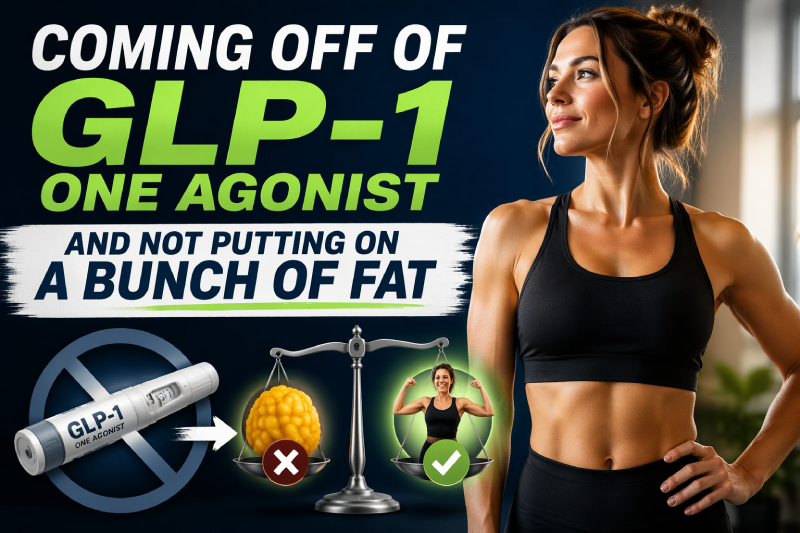
SHR #3032: Coming off of GLP one agonist and not putting on a bunch of fat
Apr 14, 2026

SHR #3025: Should You Fear the Fairway?
Feb 21, 2026

SHR #3031: The Sepsis Show
Feb 16, 2026

SHR #3030: Cheating Death
Feb 11, 2026
SHR #3029: The Ultimate Anabolic Steroid Research Guide
Oct 31, 2025

SHR #3028: Slow Aging. Prevent Disease.
Oct 23, 2025

SHR #3026: The Magic of Proper Stress Management
Dec 24, 2023


SHR #3023: The Prime Act - Getting the USDA Out From Your Farmers Way
Sep 19, 2023

SHR #3022: NAD, NMN and NR; Is There Something Safer?
Sep 18, 2023

SHR #3021: The Legend Of Christian Boeving
Sep 17, 2023
SHR #3020: The Sleep Talk
Sep 14, 2023